Tuesday, February 27, 2018

When “Demons” Meet at Lent


When the president joked (?), “shot her in the vagina,” did you know that the genitals of women victims of Maguindanao Massacre were shot and slashed? This is what I’ve learned from Commissioner Karen Dumpit of Commission of Human Rights (CHR) speaking before the delegates of the 18th National Convention of the Task Force Detainees of the Philippines (TFDP) at Arnold Janssen Spirituality Center in BF Homes, Quezon City last February 22-24, 2018.

Being a former worker of TFDP in Southern Tagalog way back in the early 90's as its human rights education regional program coordinator, I was chosen as one of the delegates to said convention. So, I took leave of absence from work going to the big city. Ms. Dumpit, by the way, is the same lady commissioner who once said in an interview that there is no need to “get into the quagmire of ridiculing other people just to make a point.”

As I have posted in my Facebook account, we gathered in this turbulent time when humane treatment to the poor and the drug addicts are considered treachery to the republic. The present government and the fanatics of the sitting president treated the human rights advocates in the same footing with the drug addicts, the terrorists and the criminals. They are considered as obstacles to whatever the former Davao City mayor wants to come about.

Long before he joked (?) to, “shoot her in the vagina,” he first encouraged the police to attack human rights groups and advocates like those gathered at Arnold Janssen Spirituality Center that day, by saying,  “If they are obstructing justice, you shoot them.” Indeed, there is also a war waged against the human rights defenders. His fanatics, his blood-thirsty on-line warriors or trolls, believe that both the drug dependents and the human rights (HR) defenders are worthy of brutal eradication. To them, we are not just “destabilizers” but “demons” coddling the drug addicts and criminals. Sadly, HR concepts and HR defenders are demonized today more than ever.

“Duterte is just a continuum of Marcos,” says Ellecer Carlos of In Defense of Human Rights and Dignity Movement (iDEFEND). Duterte effectively “demonized” human rights but under the present regime, change solely rested on violent peace and order framework while the president’s economic program is only continued from his predecessors. It is more accentuated on the market growth than human needs.  The choking-choking TRAIN is just an example! 

As emphasized by Ms. Bembet Madrid, Program Coordinator of Fastenopfer/Swiss Catholic Lenten Fund, TFDP is an activists’ organization already embedded in the Philippine social system. Established in 1974 by the Association of Major Religious Superiors of the Philipines or AMRSP, it joined hands with victims of human rights violations and their relatives, workers, students, and other church-people, peasants and other democratic forces in the country in the struggles for human rights and democracy during the dark years of Marcos’ Martial Law and onwards. TFDP existed past over 7 Philippine presidents already, from Marcos the idol, to his avid fan Duterte. TFDP, according to Ms. Madrid, continue to remain relevant by being firmly rooted to the signs of times and grounded on social realities.

The president is so adhered to his unwavering stance against human rights even before he was elected to power. His on-line mobs are all behind him ready to throw accusations at anyone who are asking humane treatment for criminals and drug addicts. Despite of this, human rights organizations and defenders must press on. The theme is challenging: Human Rights Under Fire: Human Rights Defenders Stand Our Ground; Defend the Rights of All."

Lent threatens the demon (take note that I omitted previous quotation marks on the word) or the demonic dominion in many ways. On the first Sunday of Lent, we hear the Gospel on the temptation of Christ in the desert. Let us learn how Christ triumphantly won over the demon:  He decisively rejects all of these temptations and reaffirms His unwavering will to follow the path set by the Father, without any compromise with sin or the world’s logic.

Jesus does not entertain the demon like what Eve did at the Garden of Eden. We must take refuge to God instead and answer with force and not to laugh at the demon’s “jokes”. We, the Christian HR defenders and advocates are faith-bound in the good fight that Paul taught us. This Lent, let us strengthen our spiritual armor (ref. Ephesians 6) and like Christ, we, “demons” in the eyes of king’s men, must be tried and tested for the sake of the realization of authentic change towards God’s Kingdom…

==========

Photo : Emmanuel C. Amistad, TFDP

Resources:


Friday, February 9, 2018

Ancajas-Sultan, Villa-Sencio : Pinoy Kontra Pinoy


Ancajas-Sultan, Pinoy Vs Pinoy 2

Malaki ang posibilidad na matapos ang 93 taon ay magkakaharap ang dalawang Pinoy para sa pandaidigang korona sa boksing sa katauhan nina Jerwin “PrettyBoy” Ancajas (29-1-1) at Jonas “Zorro” Sultan (14-3) para sa IBF super flyweight championship. Si Sultan kasi ang mandatory challenger ni Ancajas ayon sa itinatatakda ng pederasyon. Bagama’t sinasabing mas angat sa laban si Ancajas sa sagupaang ito, hindi rin naman maitatatwa ang hilera ng mga kampiyong sunod-sunod na tinuhog ng espada ni Zorro, kumbaga. Sila ay sina John Riel Casimero (Philippines), Sonny Boy Jaro (Philippines), Makazole Tete (South Africa), Romel Oliveros (Philippines) at Tatsuya Ikemizu (Japan).

Hesitant na tinanggap ni ALA Promotions President Michael P. Aldeguer, manager ni Sultan, ang napipintong Pinoy Kontra Pinoy 2. Ang suntukang Ancajas-Sultan ay maaring maging undercard sa laban nina Terence Crawford (32-0, 23 KOs) bilang challenger kontra sa reigning WBO welterweight champion na si Jeff Horn (18-0-1, 12 KOs). Maaaring maganap ito sa Madison Square Garden sa New York sa Abril 21. Nauna nang inihayag ng Las Vegas matchmaker mula sa kampo ni Ancajas na si Sean Gibbons ang malaking posibilidad ng Pinoy Kontra Pinoy 2 sa world championship.

Malamang sa hindi, ang labanang Ancajas-Sultan kung matutuloy (alam naman ninyo kung gaano ka-tentative ang mga bagay-bagay sa boksing bilang isports at bilang negosyo), sana naman ay huwag maging kasing low intensity ito ng unang Pinoy Kontra Pinoy nina Pancho Villa at Clever Sencio na ginanap sa Maynila noong ika-2 ng Mayo, 1925.

Actually, hindi na naman talaga imposible ang Pinoy Kontra Pinoy para sa world championship dahil sa dami ng mga kampiyon at contender sa mga mababang weight classes at sa pag-usbong ng sandamukal na boxing bodies sa planeta ngayon. Sa ganang akin, sa paglaon ay magbubukas ito sa mga bagong pangalan nating kababayan na sasabak sa world championships. Noong 2012 nga naging mandatory challenger kay WBO/WBA flyweight champion Brian Viloria si Milan Melindo pero nilakdawan siya ni Viloria, hinarap ang isang Mexicano na umagaw sa kanya ng korona. 

Sa labang Pancho Villa versus Clever Sencio na nagtapos sa unanimous decision pabor sa una, ayon sa aklat na “The Terror of Terre Haute: Bud Taylor and the 1920s” (pp 146; Dog Ear Publishing; 2008) ni John D. Wright, mas naging clever si Villa kaysa kay Sencio. Ginamitan ito ng mala-seruhanong taktika ng una, wika nga. Si Villa ang itinuturing ng mga eksperto na pinakamagaling na Pinoy boxer sa kasaysayan (Oo, mas magaling pa siya kay Manny Pacquiao dahil walang naka-knock out sa kanya noong kanyang kapanahunan). Sayaw, jab, tigil, timing, sugod at upak ang ginawa ni Villa sa bara-barang si Sencio. Estratehiyang hindi malayo sa ginawa ni Ancajas kay Gonzalez.

Pancho muna bago Pacman

Si Pancho Villa, Francisco Guilledo sa tunay na buhay, ay alamat hindi lamang sa larangan ng isports kundi simbolo rin ng pag-igpaw sa racial discrimination sa US noong kanyang panahon. Siya ang kauna-unahang Asyano na naging world flyweight champion noong 1923 at sinasabi ng maraming boxing experts sa mundo na greatest flyweight boxer in history of the game. Sa kabuuang 103 fights sa kanyang career, walang sinuman ang nakapag-patulog sa kanya sa ibabaw ng lona. Ipinanganak siya sa Negros Occidental noong Agosto 1, 1901 at natapos ang kanyang karera sa boksing nang siya ay biglang namatay sa murang edad na 23 mula sa komplikasyon sa pagpapabunot ng ngipin.

Ayon sa ilang nailathalang account, ilang araw daw bago ang iskedyul ng labanang Pancho Villa- Jimmy McLamin para sa isang non-title bout na naka-iskedyul Hulyo 4, 1925 sa San Francisco, namaga raw ang ngipin ni Villa at umaga bago ang gabi ng match, nagpabunot umano ito. Kaya noong oras ng labanan, isang kamay lang gamit niyang panuntok habang ang isang kamay ay tabon ang kanyang mukha na masakit at namamaga. Siyempre natalo ito sa laban. Ito ang kahuli-hulihang laban ng Pinoy boxing great noong wala pang internet, ESPN, HBO, Cleto Reyes Glove, Top Rank, Pay Per View at Manny Pacquiao. Panahong mismis pa lang ang pera sa panalo sa professional boxing pero bulto ang karangalan.

Tatlong araw matapos ang enkwentro kay McLamin, muli itong nagpabunot ng ngipin at natuklasang malala na ang impeksyon nito. Laban sa tagubilin ng dentista na siya ay magpahinga, nag-party ito kasama ang mga kaibigan. Lumala ang kondisyon ng kanyang impeksyon ay umabot na sa lalamunan hanggang hindi siya makahinga, na-comatose bago ma-operahan at namatay sa ospital noong Hulyo 14, 1925, 8,000 milya ang layo mula sa kanyang lupang tinubuan.

Sa Pilipinas, malakas ang paniniwala ng balo ni Pancho na si Gliceria Concepcion na ang kanyang asawa ay sinadyang lasunin  ng mga Kano na sindikato ng sugal ayon sa aklat na “From Pancho to Pacquiao: Philippine Boxing In and Out the Ring” (2013; Anvil Publishing, Inc.) nina Joaquin Jay Gonzalez III at Angelo Michael F. Merino. "Na-mafia", kung tagurian ng mga sports enthusiasts noong 70s. 

Clever Sencio, isa sa mga unang migranteng boksingero

Bangkay na rin nang umuwi sa Pilipinas si Clever Sencio (Innocencio Moldez sa tunay  na buhay) bago pa man niya maabot ang narating ni Pancho Villa sa boksing. Sa huli at ika-13 laban ni Sencio sa US sa loob lamang ng 8 buwan na pananatili niya doon, nakaharap niya ang kinatatakutang si Bud Taylor ng Indiana noong Abril 19, 1926.  Nakipag-bugbugan si Clever sa Kano na tinaguriang “The Blond Terror of Terre Haute”. Ang laban ang isa sa mga naunang naitalang madudugong laban sa ring sa kasaysayan ng Milwaukee na siyang venue ng laban. Natalo si Sencio sa umaatikabong suntukan na tumagal ng 15 rounds.

Nais sanang bumawi ni Clever Sencio ang naunang pagkatalo ni Pacho Villa sa kamay ni Bud Taylor. Ngunit hindi niya naipag-higanti ang pumanaw na kababayan na kanyang nakatunggali sa Maynila wala pang isang taon ang nakalipas.

Matapos ang laban, bugbog-saradong bumalik sa kanyang hotel si Sencio. Makaraan ang ilang oras, siya ay uminda ng tinding sakit ng ulo. Pinakalma siya ng kanyang trainer na si Walter Eckwart. Hanggang sa matapuan na lang nila siya sa silid ring iyon na dumudugo ang bibig at ilong at walang malay. Isinugod siya sa ospital ngunit ilang minuto lang ay namatay na ang boksingero sanhi ng cerebral hemorrage na nauna niyang natamo sa laban kay Taylor.

Magkahiwalay na tinalo ni Bud Taylor ng Amerika sa umaatikabong suntukan sina Pancho Villa at Clever Sencio ng Pilipinas sa bansang sumakop dito matapos ang mga Kastila.

Pagluluksa ng mga kababayan

Binigyan ng funeral service si Clever Sencio sa St. John’s Cathedral, at ayon pa rin sa tala ng manunulat na si Wright sa nabanggit na aklat. Si Fr. William E. Wright na namuno sa gawain ay maramdaming nagpahayag ng ganito: "He died a stranger in a strange land and in our hearts we think of those in a faraway land who will mourn for him. Only Monday night we saw him fight and put all that he had into that fight that he might win. Neither he nor you could realize that today his body would be resting in this casket, which cannot but impress upon us the shortness of this life."  Boksing ang nagpadpad sa tulad nina Pancho Villa at Clever Sencio sa malayong lupain at kamatayan lamang ang nagbalik sa kanila sa kanilang lupang tinubuan. Kagaya ng iba nating kababayan ngayon doon. 

Nang parehong mamatay sa ibayong dagat ang dalawang kayumangging mandirigma sa parisukat na ring noong magkasunod na taong iyon, nagluksa ang kanilang mga kababayan. Sila na mga migranteng manggagawa na karamihan ay kinontrata ng mga kontratistang Amerkano para magtrabaho sa mga pataniman ng prutas halimbawa sa California, Oregon at Washington. Naging simbolo sila ng pagkakaisa ng kanilang mga kalahi at ng pag-asa na maari silang maging kapatay o higitan pa ang mga puti sa mga larangang malapit sa puso ng mga Kano tulad ng boksing. Kabilang sina Diosdado "Speedy Dado" Posadas at Ceferino "Bolo Punch" Garcia sa mga namayagpag na Pinox boxers noon sa US.

Walang todong tunggaliang Pinoy Kontra Pinoy sa kampiyonato ng totoong buhay sa ibang bansa sa panahon nina Pancho Villa at Clever Sencio....


(Photo; PhilBoxing Photo)
========
References:


Friday, February 2, 2018

Will Be Watching Ancajas Win


Me and my eldest will be glued on ESPN TV5 this coming Sunday, February 4 in the Philippines, to see Jerwin Ancajas (28-1-1, 19 KO) defend his 115-pound crown against Israel Gonzalez (21-1, 8 KOs) at the  American Bank Center in Corpus Christi, Texas. But this, I believe, is a lopsided fight and the Filipino boxer will retain his crown for his 4th defense. It's a KO for sure in the latter part of the match.

I was able to rubbed elbows with Ancajas when he visited Sablayan in July 22 last year as guest in a professional boxing occasion here. He was invited by fellow boxer, the home grown talent Drian Francisco, to grace the event. That was just 20 days after Ancajas’ bout against Teiru Kinoshita in Brisbane, Australia. He posed with my son Yobhel Viktor as you could see in the photo above.  

In case you still do not know, Drian Francisco, the former WBA super flyweight champion, lost via UD (96-94, 98-92, 98-92) in his January 27, 2018 outing against Edivaldo Ortega at Auditorio Municipal in Tijuana, Mexico. Drian is now 35 years old.

Let us go back to Ancajas. The Panabo City-born pugilist handled by Joven Jimenez is boxing as a professional since 2009 and became the first fighter promoted by Pacquiao's MP Promotions to win a world title. Jimenez himself will be the main man in Ancajas' corner. Let us hear from Bob Arum himself on Ancajas: "As he matures and settles down, he could be a fighter of the style of Manny Pacquiao. Not to say he will be as great as Manny Pacquiao. That's a lot to ask of anybody and it's not fair to ask. But he has that same crowd-pleasing style. I think he can go a long way."

My fingers are already aching trying to find over the net any clips or stories about Israel Gonzalez, his opponent, but to no avail. I therefore believe that this Mexican boxer is unremarkable or one of Mexico's secret nuclear warheads.  Well, he is a ranked Super Flyweight boxer and former WBC FECOMBOX Super Flyweight interim champion and current IBF #10 Super Flyweight. Other than such information, I cannot find any vital information about him.

This is Ancajas' debut in the US allright. He is often being compared to Manny Pacquiao. Pacman's US debut happened in June 23, 2001 against the then IBF Super Bantamweight champion Lehlohonolo Ledwaba. Pacquiao then was the challenger. In Ancajas case, he is the title holder while Gonzalez is the challenger. The Pacquiao-Ledbawa fight was held at the MGM Grand Garden Arena in Las Vegas. Pacquaio stepped into the brawl as a late replacement on 2 weeks notice but it was the first time the world witnessed the fist that is about  later to shake the world. On the other hand, Ancajas went to Texas with a figure of  Sheriff Woody  printed on his shorts fully prepared to defend his crown. 

What I am really eager to watch (ESPN TV5 is all I can afford) is the fight between Jerwin Ancajas and Srisaket Sor Rungvisai (ศรีสะเกษ .รุ่งวิสัย) (44-4-1; 40 KOs) of Thailand. That is if Ancajas will win, (and he will surely do convincingly) in his battle against the Mexican and Rungvisai would win in an about to be finalized match against Juan Francisco Estrada (36-2-0). Rungvisai is HBO’s 2017 Fighter of the Year awardee.

Ancajas-Rungvisai is as exciting as GGG-Canelo 2. The best fights in my list for 2018...

--------
References:


Tuesday, January 23, 2018

Me & the Famous Normans


When movie fans think of Norman, they may only think of Alfred Hitchcock’s Norman Bates. He is the main character in the 1960 movie “Psycho”. Do not fear me for there are a lot of Normans who are not psychopaths. No pro-charter change Philippine congressman is named Norman, by the way.

I am not the ideal boyfriend in Sue Thompson’s hit song “Norman”, it was released in 1961 and I was born in 1962. Unlike in the song, I never had a date in high school. But I am a great lover in my own little way since birth. I am a lover of truth, wisdom, beauty and reason. My mother, my close friends, my children and my wife could well attest to that.

My first full length exposition to the life of Jesus was in 1973 by way of “Jesus Christ Superstar”, a film directed by Norman Jewison. It’s my first taste of understanding the deity of Jesus, a working Jewish’s son (all pun intended). Since then, I am no longer amazed why priests sing during masses. I also dreamed of being a priest but worked for them (or was it for the Church?) instead for the most of my years. There I was exposed to the Catholic social doctrines and really influenced by Carlos Abesamis’ book “Third Look at Jesus”.

To those who follow Philippine basketball, the name Norman Black is very familiar. This Norman, first recipient of PBAs Mr. 100% Awards, played 66 games for San Miguel Beer in 1981 onwards and averaged close to 43 points per game and in that same year, I dropped out from college, tired of the teachers doing nothing but instruct their students copy lessons from the blackboard the whole semester. Later, I was given a chance to work as a gymnasium barker in 3 outings for the San Jose Summer Basketball League though I didn’t play an official basketball game ever in my whole life.

In 1992, the biofilm of Dr. Norman Bethune titled “Bethune: The Making of a Hero”, one of the first large-scale Western productions in China where he was hailed as a hero and a saint, was shown. The Canadian doctor cured the injured red fighters of Mao Ze Dong’s people’s army right at the battle field. Embracing the revolution and the communist ideology, Bethune’s ideas stormed debates both in the medical and political fronts all over the world. Two years before 1992, I was involved in student activism and right after I got my diploma in Bachelor of Arts in Secondary Education, I landed as the human rights worker in a church-established HR institution. While the movie was having its premier elsewhere, I started a family of my own praying that my marriage would not be riddled with conflict and controversy like that of Bethune. My prayers are heard. I lied low sloganeering in the streets. The welfare and total development of my children became subjects of me and my wife’s Hasta Victoria (my apologies to the memory of Che Guevara) battle cry. Incidentally, my spouse’s given name is Victoria, in case you do not know.

Year 2012 marked the 19th death anniversary of Rev. Norman Vincent Peale and his minions around the world re-affirmed his teachings regarding positive thinking. Somebody offered me then to work in government and lost worker I was in the barren vineyard of rotten grapes, I accepted it. Norman Vincent Peale’s teachings on positive thinking, according to his followers, are all expressions of his belief that people had the ability within themselves to better their lives. My mother happened to read one of his books just few months before I was born. I guess it’s the “The Power of Positive Thinking” which sold millions of copies and been translated into more than a dozen languages today. Thinking positive made me acquainted with my new environment which is 2-hour ride away from home. In the league of positive-thinking visionary public servants, I found a new home.

The most prominent Norman in television today is Norman Reedus, actor-model and star of “The Walking Dead”. It is a horror-drama TV series which is still running today in the US and around the globe. Since I get into a medical condition many years back, I reduced my activities which require much physical exertion following the advice of my doctors. I reduced taking fatty and salty foods including sugary beverages. Gradually in my life, I reduced everything that is softly killing me physically, mentally, spiritually and morally. I greatly reduced the badness that I used to do when I was young. It’s now 2018 and thanks to God I reached my 56th natal day today. “Norman Reduced” (just to make it sound like Norman Reedus), that is what I am now, still walking, alive….


Monday, November 13, 2017

Occidental Mindoro: 67 years and counting


The grandest event in Mindoro Island’s history after World War-II was its disunion into two provinces. The division of the two coasts gave birth to both Oriental and Occidental Mindoro. That time, there were no transportation connecting east and west coasts therefore the political administration from Calapan, which is Mindoro Province’s capital then, was very hard, time-consuming and costly. This marked the birth of both Oriental Mindoro and Occidental Mindoro.

The Philippine Congress passed Republic Act 505 officially dividing the island into two provinces and in inaugural ceremony held on November 15, 1950 in Calapan, the formal transfer of all official functions materialized. RA 505 was approved on June 13, 1950 by President Elpidio Quirino and was finally penned into law on November 15 on that same year. This is the fruition of HB No. 640 sponsored by the then lone province’s representative Cong. Raul T. Leuterio.

But according to Volker Schult in p. 116 of his book “Mindoro : A Social History of a Philippine Island in the 20th Century” published by the Divine Word Publications 1991, “He (Leuterio) paid back the political loyalty the Abeledas had been giving him since the pre-war period. Leuterio supported the Abeledas to gain political domination in the province of Occidental Mindoro.” During those days, political power is exclusive to certain elites in society or political factions, not unlike today.

Expectedly, Damaso Abeleda was appointed governor from November 15, 1950 to December 31, 1951. But our first elected governor was Federico Castillo (1952-1955), while Jesus T. Abeleda (1951-1953) became the first congressman of Occidental Mindoro. Occidental Mindoro will be celebrating its 67th founding anniversary this Wednesday.

As I have mentioned, there was a ceremony held in Calapan and in the following day, a similar ceremony was held in San Jose. The latter, in case you do not know, was the first capital town of Occidental Mindoro until a group of influential citizens and families started a campaign pushing for Mamburao as the new capital. With their political influence and clouts, the move succeeded. Since January 1, 1951 up to present, Mamburao has been the capital of our province where the stronghold of said elites can be found. Mamburao, the capital town, by the way, was not included in 5 Occidental Mindoro municipalities vested with the prestigious Seal of Good Local Governance (SGLG) Award by DILG. For 7 years now since it was launched as Seal of Good Housekeeping in 2010, SGLG has been a vehicle that drives the LGUs to aspire for better programs and policies. 

Truth to tell, debt of gratitude in politics is part of our province’s infantile period in history as attested by the events prior to the separation of Occidental Mindoro from its western-side twin. Those days of political exclusivity, where the elite politicians take the centre stage and the “nameless” and “unknown” public servants are left without any chance in terms of governance.

The provincial political leadership in the province been dominated by two camps of political titans for nearly 3 decades now. The occasion's theme is, "Reaching Progress in 2017". 

God gave us 67 years to correct those but  gerrymandering of old haunts us still to this very day.

-----

(Photo grabbed from Jasmine Marcelo's Facebook account)


Monday, July 31, 2017

The Semirara-San Jose energy connection


The island and the company

Semirara, a 5,118-hectare island is within the jurisdiction of Municipality of Caluya in Antique province, lies between mainland Mindoro and Panay. From San Jose (Occidental Mindoro), it would take about 4-5 hours by ferry boat.

The Semirara Mining and Power Corporation is the biggest producer of coal in the Philippines. Apart from coal, the once marine life-rich island has other mineral reserves that the company has the right to explore and mine. The whole Semirara island has about 824 thousand tons of silica, 1.2 billion tons of limestone, and 2.9 million tons of clay. The Municipality of Caluya’s poverty incidence in 2013 is pegged at 47% but on that same year, the mining company, in stark contrast, posted a P12.6 billion revenue for coal production.

With regards to the coal mining, the Department of Energy (DOE) granted the extension of the company’s Coal Operating Contract until July 14, 2027. The Semirara Mining and Power Corporation or simply Semirara, is part of the DMCI Holdings, Inc. Aside from coal mining, the group is operating power, property and nickel mining businesses. DMCI Holdings, Inc. has allotted P14.5 billion to Semirara for capital spending onwards. At present, the coal company is steadily increasing its capacity to a maximum of 16 million metric tons of coal to cope up with the approving prices and demand of the local market. This 2017 is also planned to be a year of updating the company’s operations and maintenance programs to improve efficiencies of its power plants. Therefore, there goes the proposed coal-fired power plant in San Jose, Occidental Mindoro.


Its reserve and power capacity

In November 2004, an independent technical review conducted by Minarco Asia Pty Ltd. It shows that in the Panian Pit is estimated to have 52 million MT of already available coal while there are still 210 MTs of in-situ (requiring an additional confirmatory drillings to show that the reserve is proven and recoverable) in the pit. Inside another pit, Himalian Pit, there is a potential 52 million MTs of in-situ coal inside it.

Two years later, in December 2006, consultants from Australia supervised the confirmatory drilling in Panian Pit and as per standards of Australia’s Joint Ore Reserve Committee or JORC, 62 million MTs and 6 million MTs of coal were categorized. The Panian Pit is the place where several workers died due to a landslide incident in July 2015.

On July 11, 1977, the Energy Development Board, precursor of the Department of Energy (DOE), awarded a 25- year Coal Operating Contract (COC) to a group of three private companies, incorporated as Semirara Coal Corporation or SCC and in 2004 it changed its name to Semirara Mining Corporation or SMA and later became the Semirara Mining and Power Corporation. The DOE is most likely to renew the coal extraction contract every time it expires, or at least that was the expectation of the mining firm.

Semirara is the only power producer in the Philippines that owns and mines its own fuel source which is coal. According to them, their whole operation can produce 8 million MTs of coal per annum. Reportedly, the expansion of the coal mining operations, which involves an estimated 10,000-hectare area, is already 5 to 7 KMs off the shore. The company boasted that it has an installed generating capacity of 600MW, with an additional 1,200MW in the pipeline. Occidental Mindoro to date has only a peak-hour demand of 19 MW of electricity.

Meeting the SP and the EC

The Provincial Board of Occidental Mindoro in its Facebook account reported that last June 16, 2017,  the so-called “unified leaders” (the Sato-Mendiola local political faction) had a meeting with some top brasses of the DMCI Power Corporation and the Semirara Mining and Power Corporation regarding the conglomerate’s proposed coal-fired power plant. Further, the provincial board stated that because of the 12.17% annual power growth demand of the province, the current power suppliers can no longer be enough for such a huge demand in the future.

The social media post which was quoted here in verbatim further states, “Three options for this proposal is presented. Option 1, to be constructed in mainland San Jose, Option 2 in Ilin Island while Option 3 is the Semirara Mine Mouth. Our leaders are taking into consideration the environmental impact and the like for this project. On the other hand, the geothermal plant being eyed in Naujan is not feasible and so the government is looking for other options to address the province’ current power situation.”  With the fragile island ecosystem of the island, the provincial board is bound to weighing matters in its legislative scales.

The members of the Sangguniang Panlalawigan (SP) are aimed at increasing 20 MW diesel power plant of the Occidental Mindoro Consolidated Power Corporation (OMCPC) in the town of San Jose.

Weeks after the SP meeting top political leaders, according to sources, went to Semirara for an ocular inspection and reportedly fetched by the company’s private plane from San Jose to Semirara. No result was disclosed to public as of post time regarding the visit.

On July 8, 2017 on the other hand, same representatives from the DMCI Power Corporation oriented the Occidental Mindoro Electric Cooperative (OMECO) Board about their company and later expressed their willingness and intent to participate in the Competitive Selection Process (CSP) in due time. The electric cooperative (EC) just listened to them and no assurances or whatever was given by its Board. OMECO reportedly eyeing for another independent power producer to join the bidding. This IPP is projected to establish a diesel-fired power plant in Mamburao and the project is anchored on the EC’s energy development plant for the province.

But prior to the two presentations in two different bodies, Mindoro’s electricity requirement is being supplied by the National Power Corp. (Napocor) through its missionary electrification and DMCI Power Corporation which is an affiliate of Semirara. DMCI Power Corporation provided power rentals for Napocor for some time until the OMCPC came in.

By 2018, the 25-year Energy Conversion Agreement (ECA) entered into by OMECO and Island Power Corp. (IPC) will finally expire, finally allowing more investors to invest in Occidental Mindoro. The Semirara Mining and Power Corporation is one of the prospects.


Coal : Dirty and mean


Coal is considered by the environmentalists as the dirtiest fuel on earth. Many countries in the world considered coal as fuel for global warming that is why many of the coal mines are banned in many parts of the globe. Philippines is host to 10 coal-fired plants and majority of which are located in Mindanao.

It is a nation-wide call of environmental groups to continuously campaign in convincing the government to shut down all or most of the plants and replace them with facilities that tap renewable energy. They insist “green energy” like solar, geothermal and wind over “dirty energy” like coal. According to Owen Migraso, executive director of Center for Environmental Concers (CEC), “The government should not pursue coal to generate electricity for industrialization. Technology is available in developed countries. There are technology transfer laws. The important thing to consider is how renewable energy will benefit the people.” According to an EC insider, solar is the only feasible renewable energy in Occidental Mindoro. 

Passive populace

Though the people of Occidental Mindoro is yet to be informed on the details of the project, vigilance is deemed by some local environmentalists, both in the government and the public sector, as a future course of action.

Occidental Mindoro in general, San Jose in particular, is not known to such active and massive pro-environmental issue-projection and mass actions since time in memoriam. It is a reality that any aggressive anti-environment project can easily exploit. 

------------
(Photo: Business World)
---------------
References and resources:
http://www.philstar.com/business/2017/02/27/1676013/semirara-supply-power-mindoro

Thursday, July 13, 2017

A Thunderous Boxing Night


Like what occurred in Brisbane, a boxing event can be a tourism knockout! Well, at least there’s something for us to look forward to.

Pacquiao and Ancajas

Oddly enough, the defeat of Manny Pacquiao against Jeff Horn overshadowed the victory of Jerwin Ancajas (27-1-1) over Teiru Kinoshita. Common people keep on talking about Pacquiao's loss but hardly talked about Ancajas' winning glory. Ancajas' first-rate performance against the Japanese to retain his IBF Super Flyweight championship belt at the Suncorp Stadium in Brisbane, Australia was remarkable. Ancajas won via 7th round TKO pounding the challenger's body sending him to the canvass like a crumpled bonbori lantern.

The Ancajas-Kinoshita duel was the co-main event of the Horn-Pacquiao last July 2. With the effort of one of Ancajas’ corner men, the home-grown boxer himself, Drian Francisco (29-4-1), the IBF champ will be coming over to grace another professional boxing fest here. Francisco and Ancajas are stable mates in Pacquaio’s MP Promotions. The former is two-time chief spar mate of the latter.

The Main Event

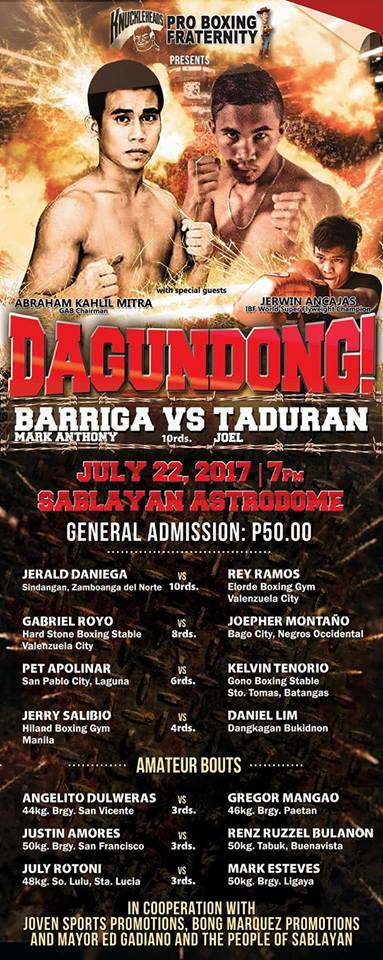
Billed as “Dagundong!”, the slug festival is presented by Knuckleheads Pro Boxing Fraternity. It will be held at Sablayan Astrodome on July 22, 2017 featuring the ex-Olympian Mark Anthony Barriga versus Joel Taduran in the main event. In 2012 London Olympics, Barriga lost to Kazakh fighter Birzhan Zhakypov by just a hairline, 17-16, in their round-of-16 light flyweight match. The referee slapped the then 19-year-old Barriga with a one point deduction in the third round for ducking (which is illegal in amateur boxing) the Kasakh and lost it by points.

But as a pro, Barriga bounced back. In his debut in July last year, he won a UD competing with Melvin Manangquil in Cebu City. He has never fought outside of the Philippines as a professional. His latest fight was held only June 4 at Dipolog City winning a TKO versus Marlou Sandoval. With just more than a month after his last ring appearance, Barriga will be again crossing the ropes here in our province. 

How about his opponent Joel Taduran? Well, with a total of 15 fights across his name, Taduran slightly has the experience. He already boxed outside the Philippines- Japan, China and Indonesia. His first fight abroad was at the Korakuen Hall in Tokyo where he was frustrated by Toshiyuri Igarashi in May 7, 2016 via UD. In his last fight, he was TKOed by Junto Nakatani on April 16 this year at Messe Mie, Tsu, Mie, Japan.   

The province’s boxing capital

Boxing, even before the first two professional fights of Manny Pacquiao were held here in the mid-90s, is the most prominent sports among the youth in town. Promotion of boxing is embodied in Sablayan’s Executive-Legislative Agenda for 2016-2019. Sablayan is considered by officials from Amateur Boxing Association of the Philippines (ABAP) and other international boxing personalities as the Boxing Mecca of Occidental Mindoro. Former Palawan governor Abraham Khalil “Baham” Mitra, the current chair of Games and Amusement Board (GAB), will also be coming over to supervise the event.

Sablayan Astrodome was the venue of the Drian Francisco- Pichitchai Twins Gym duel for the IBF Pacific Super Bantamweight championship. Francisco won via first round knockout over Thailand's Pichitchai Twins Gym to capture the interim title. Francisco, fighting in his hometown for the first time in his career, delivered a 3-punch combination that sent the Thai crushing to the canvas and was counted out at 33 seconds of the first round. The brawl took place in April 15, 2012.

The sensational fistfight between Jimmy Borbon and Jonard Postrano (2016-01-21) was also held at Sablayan Astrodome and hundreds of other events that cannot be accommodated here for lack of space. Sablayan too, is home to boxing trainers like Joe Francisco, a former Philippine #1 Philippine Junior Featherweight contender, and promoters like Cecilio Alvarez, Sr. of the JBoy Promotion.

Budding local pugilists

It is on record that the amateur boxers from Sablayan excel in many boxing tournaments like the Provincial Meet, the MIMAROPARAA, Palarong Pambansa, Batang Pinoy and those sponsored by DepEd, PSC and the LGU. The Municipal Government led by Mayor Eduardo B. Gadiano and SB Walter B. Marquez, a boxing promoter himself, also sponsored the event as they continue to support the town’s local boxers.

Aside from Drian Francisco, the current roster of professional boxers from Sablayan includes Rodynie Manzano Rafol and the two budding professional boxers in Darren Collamar and Lloyd Dulweras, to mention just three. The list should be long and the sport must not be neglected. The province’s boxing tradition must continue.

Sports tourism

Pacquiao’s nemesis Juan Manuel Marquez once said, “Boxing is always serious.” Promoting and developing sports tourism should be seriously looked into. Especially now that Boxing and other sports are considered attractions within the broader context of local tourism industry.

-----

(Photo: From Drian Francisco's FB account)


Monday, July 10, 2017

SaltPhil Remembered


These are visible remains of the Salt Industry of the Philippines or SaltPhil.- the nearly immortal logs gallantly standing there defying the stormy sea through the ages. Greek thinker Pythagoras (born at around 570 BC) said, “Salt is born of the purest of parents: the sun and the sea.”

I was nurtured by a salt maker just like all the children whose parents were pillars of early industrial salt-making in this part of Occidental Mindoro.  We are gypsum, a salt by-product, figuratively speaking.

Pillars for salt-making

SaltPhil was the biggest manufacturer of industrial salt in Southeast Asia and established on April 27, 1955 and was under the Compania General de Tabacos de Filipinas or Tabacalera. The company then rented an 800-hectare (some accounts says it is 1,200 has.) of coastal land from the Philippine Milling Company when Sugar Central closed down in the early 50s due to poor management. The vast land covered parts of Bubog and San Agustin, two seaside barrios of San Jose-Pandurucan. The method of salt production used by SaltPhil is the evaporation of salt brine by steam heat in large commercial evaporators called vacuum pans. This method, according to my current readings, yields a very high purity salt, fine in texture, and principally used in those applications requiring the highest quality grains.

But in the early-80s, the factory stopped its operation and many of its labourers, my father included, were laid off from work. I was told by my mother that the factory went bankrupt. The whole property was later purchased by Filipinas Aquaculture or AquaFil and turned it into big prawn hatchery. Only the main factory and parcels of land nearby were utilized by the new company while the other facilities or features elsewhere are now already abandoned including the well-founded poles shown in the picture above. The poles I used to stare from our window during an inclement weather while the angry Buslugan River is roaring from afar. We transferred from our former house near the seashore when it was nearly devastated by a storm surge way back in 1970.

What is the purpose of those poles, actually? Their main use is to hold cables where a machine-operated bucket is attached. The bucket, about two meters in width, is operated by a machinist at the elevated engine room in a place they call “Water Intake”. Its primary duty is to make sure that the opening of the saltwater to the pool is sustained. The Water Intake’s bucket pushes the volume of sands seaward thus keeping the mouth of the pool open. A bulldozer below the Water Intake operated by Antonio “Lagang” Aguilar complements the function of the bucket. The heavy volume of seawater is continuously pumped to dozens of giant salt ponds to the factory itself in Sitio Curanta, southern part of Barrio San Agustin.


The post- SaltPhil violence

By the time the new government of Corazon C. Aquino was installed by the EDSA People Power, the vast land owned by the AquaFil, the precursor of SaltPhil, was placed under the Comprehensive Agrarian Reform Program or CARP by the new administration and the AquaFil years before it ended its operation.  The property was occupied later by the farmers from all over the place who joined the Kilusang Magbubukid ng Pilipinas (KMP) rallying for genuine agrarian reform. Group of former SaltPhil and AquaFil labourers also petitioned for land occupation but its individual members later joined the KMP. During the initial years of the Aquino presidency both insurgency-related and politically-motivated acts of violence in our province have increased. High profile cases of human rights violations have escalated especially in San Jose and Sablayan where militant farmer leaders were executed. CARP has polarized social groups in Occidental Mindoro costing many lives and limbs. Significant cases happened during massive military deployment at the AquaFil Estate where many of the farmer members of the KMP were detained and arrested. Law enforcers and security officers of the property were not spared and even targeted by Communist hit squads. Some of the farmer-leaders even joined the New Peoples’ Army (NPA) after being hunted by the police and Philippine Constabulary (PC) soldiers while the others struggled through peaceful means and critically engaged with the program implemented by the Department of Agrarian Reform or DAR. This was an offshoot of the infightings among the national democratic forces then.

Fishponds and saltbeds like those of SaltPhil and Aquafil are by law exempted from land reform but that time they are idle and should be covered by CARP. Without the vigilance and collaborative spirit of the people around AquaFil, the fishpond estate would have to be out of the program’s coverage.  Today, majority of the landholdings were agriculturally productive after being legally acquired by the petitioners. The days of violence, like the SaltPhil and the AquaFil, are now gone.


Glory days

It is very fascinating to watch the tug boats towing around 6 barges coming from Sitio Curanta crossing the calm South China Sea. Tons of salts are being transported from the company’s private seaport to other part of the country. In 1958, SaltPhil had produced and exported to Manila 19,000 metric tons of refined salt.

It is near the main factory where the tenement houses of the top executives and employees of the factory and their families reside. The office of the labour union and the cooperative store shared the same building. The store at one time was managed by Mr. Perfecto Paguia supplying basic commodities needed by the employees and labourers both on cash and credit basis. Spirits and cigarettes are also available.

The tributary canals going to the salt ponds and beds are abundant of shrimps, crabs, prawns and all other edible crustaceans aside from milkfish, tilapia, paetan and the rest of the fishes effortlessly caught in saline marshes within the property. Finding such a free or affordable viand is easy way back then. The present day “food of the rich” can definitely be devoured upon by the working class those days.

The Divine Word College of San Jose, San Jose Pilot Elementary School and the Saint Joseph School catered the educational needs of the children of the officials of the firm. The resident employees lived inside the compound of the company together with their families.

A family Christmas Party is annually sponsored by the management. Dressed as Santa Claus, the resident manager distributes gifts, mostly toys, for their employees’ children. There were parlour games for the kids and songs and dances for their parents. The ladies are wearing their floral designed Momo dress and the gentlemen in their Macomber and Bestman pants. It was the only time of the year when we, the children of the labourers, could taste chocolates, apples and ice cream.

In the 60s, there was still no electricity in Barrio Bubog and Barrio San Agustin and only the facilities of the SaltPhil have electricity such as Check Point Number 1 (which is actually a guard house), the entry point to the factory. It was located just a few steps away from our new place in the barrio proper.

Since the Check Point is the only electrically-lighted area in the barrio, children of my age used to play near it at night especially during weekends. Once a month, the SaltPhil management offered a free movie for the residents from a portable projector and makeshift screen nailed into the electric post. I remember that the last movie I saw there was Anthony Mann’s 1964 film “The Fall of the Roman Empire”. After less than a decade, the SaltPhil, due to the prevailing political and economic changes that time, fell like the Roman Empire. Like the so-called “Last of the Romans”, the SaltPhil employees and labourers scattered like grains of salt in the crockpot of changing social realities of the era. Some of them even worked abroad.

Salts of the earth

My old man worked as a pump tender alternating with a fellow named Johnny Orozco in Pump House Number 1. The Pump House cloisters the six-cylinder Buda Engine made by the Buda Engine Company. It was founded in 1881 by George Chalender in Buda, Illinois, to make equipment for railways. The main bulk of my father’s job is to make sure that the engine is properly maintained adjusting the volume of the seawater to be conveyed to the ponds. Since his work does not require much mobility especially during graveyard shift, he has a lot of time to read pocketbooks. He is fond of Erle Stanley Gardner’s Perry Mason series. When the officials of the company moved out, my father brought home volumes of Reader’s Digest’s compilation of short stories and other pocket books handed to him as mementos from one of his bosses, the company accountant Mr. Pedro Nillo, a voracious reader like my old man.

My father’s eldest brother, Pantaleon S. Novio, Jr., was one of the company’s trusted mechanics. From their ancestral home in 132 Capt. Cooper St. in the town proper, my father Manuel and my Papa Addie brought their families in Barrio Bubog where my uncle served as barangay captain for more than 20 years. My father was one of the officers of the company’s labour union. Aside from the poles, the long cemented water canal from the former site of Pump House Number 1 stayed even to this day. Just like the lessons left behind to their children by the two Novio siblings of SaltPhil.

The overall boss was Engr. Alfredo Yleaña, the company’s resident manager, former mechanical engineer of the Central Azucarera de Bais in Dumaguete but was born in Jaro, Iloilo.  Yleaña first arrived at SaltPhil in 1958 and initially became its plant supervisor where his superiors are all pure Spaniards. He later promoted as SalPhil’s resident manager and took the helm from the foreigners. Engr. Yleaña was a heavily-built man, around 6’ 2” feet in height and wearing thick eyeglasses. With his Ilonggo accent in a baritone voice, the resident manager expresses authoritative but kind instructions and orders. He was a generous and caring and always accommodating to those in need. He was an active official of the Knights of Columbus in San Jose. Engr. Alfredo Yleaña at 59 died on January 17, 1980 leaving his wife Mafalda and their children behind. One of his children, Grizelda, is a long-time friend of my aunt, Helen.

I was in high school when chess great Bobby Fischer is at the height of his popularity and fame. I and my classmates, Danilo Solomon, Winifredo Oracion, Roberto Paulmanal and the late Joel Boongaling were into chess. I never did win a game against any of them. Knowing about my inept skill in the board game, my father told me once that he’s going to introduce me to the expert wood pusher of SaltPhil, Engr. Leto E. Nicanor. But that meeting did not happen for reasons I do not know. My friends continued to butcher me over a chess game until I gave up playing.

Leto E. Nicanor is an electrical engineer and an alumnus of Mapua Institute of Technology. He, as a young bachelor, first set foot on the shores of SaltPhil on February 1965 and served as its shift engineer. He first stayed in the compound but later rented a boarding house in the town proper which is more or less ten kilometres away from the factory. Engr. Nicanor tied knots with Milagros Espinas, a teacher at Pilot Elementary School, in November 1965. After 14 years in SaltPhil, Engr. Nicanor resigned and worked as power plant superintendent of Occidental Mindoro Electric Cooperative (OMECO) for a time. I don’t have a chance to introduce myself to him each time I watch him play chess in a barber shop of downtown San Jose or under the Talisay tree near the San Jose Water District Office. I have already lost my enthusiasm in playing chess, anyway.

Prospects of salt-making in Occidental Mindoro Today

Our province is bounded by saltwater making it one of the biggest salt-producing provinces in the country even today that the SaltPhil is long gone. At the height of the province’s production in 1990, Occidental Mindoro boasted of producing and supplying about 60,000MT of the 338,000MT or 18% of the country’s annual salt requirement. Today, while our province still provides salt in neighbouring provinces in Southern Luzon, Visayas, and Mindanao, only 12% national salt requirement or almost 75, 000 MT of 590,000 MT comes from Occidental Mindoro.

But today, Occidental Mindoro salt industry is already dwindling due to climatic factors and insufficient technology. The provincial government and the industry stakeholders should exert extra effort to keep it more vibrant and competitive by providing additional salt production technologies various programs that the local government failed to seriously look into. The industry needs to be revitalized though researches and innovations to re-boost the industry. Without it, the province’s salt industry will in the end drop its taste.  


A chemical practice

It is said that salt production is one of the oldest chemical practices performed by man and equally true, memoirs are brought about by chemical reaction processed by his aging brain.


---------
(Photo: Pipay Novio)
----------
 “Stories of 100 Families”, Rodolfo Meim Acebes


Wednesday, June 7, 2017

Singaporean star goes to Sablayan


Udaya Soundari, the actress-host from Singapore, is the latest celebrity guest who came to Sablayan and experienced the places and faces this trailblazing town in Occidental Mindoro has to offer. And who am I to refuse her begging to pose for a photo with me. I am just kidding, of course!

Seriously, Udaya and the rest of the television crew visited various places in town and mingled with the people and immersed in some of our tourist spots last June 4 to 5, 2017. Unknown to the local folks that she rubbed elbows with, she is a heck of a celebrity in Singapore’s Tamil TV history. Udaya is the first individual to win three-layered awards in just a year in an annual ceremony which bestows citation to artistes in a Singaporean Indian television called Pradhana Vizha. The team from Asia-Medicorp, Singapore and Verite Productions visited the Parola Park, the Apo Reef, Pandan Island and the Alangan Mangyan community of Calamansian for video shoots. They all experienced riding the longest island-to-island zip line in the world.

As I have said, Udaya made it to the local Tamil TV history for she is the first person to win three awards in one year in an annual ceremony which honours the best in local Indian television. Never in the past Pradhana Vizha awarded more than one winner since 2012 and our recent guest bagged three: Best Actress, Best Host (Info-Ed) and Most Popular Female Personality in 2014. In retrospect, Udaya got hit the magic pot in the TV industry in 2007 as a contestant on reality TV singing competition Vasantham Star, in which the beautiful lass shown in the picture above (with me) landed on the top 10.

But not everything went smoothly in her career. She figured in a certain issue in 2015 and was side-lined for some time. But because she’s a big, big talent, figuratively speaking, she was able to come back and continue to inspire aspiring artiste of this generation. But that was already water under the bridge and now diluted in high seas of detachment and impertinence.

Many guests from all over the world considered Sablayan as the epicentre of economy and politics Occidental Mindoro and home of true champions of sustained ecotourism and participatory governance. Sablayan’s approach to tourism development is not only limited to promotion of tourism areas. Enterprise development is perceived as basic strategy towards empowering community members to earn supplemental income from the tourist traffic through various economic endeavours and income-generating approaches.

But of course media projection is important especially if it is shown in other part of the globe. That is the story the production is going to tell where Udaya Soundari, the artiste par excellence, acts as program host whom in her heart entertainment is a passion…

-------

(Photo : Pauline Licop Gilongos)

--------


References: