Wednesday, March 16, 2011

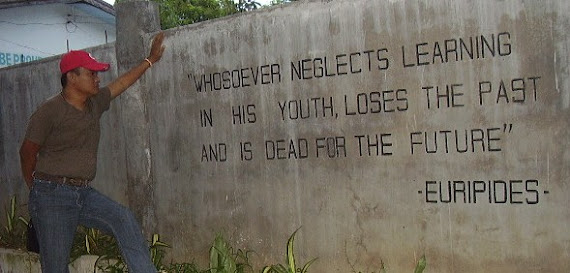
Transfigured Learning?


Somebody posted this arresting question for a thread in our Facebook group some days back: “Ano na bang nagawa mo sa Mindoro?” (What have you done for Mindoro?) A question addressed to us members. Sensing that the poster-initiator is a teacher by profession, I thought she’s just employing one of the contemporary teaching strategies defined in the 2002 Basic Education Curriculum (BEC) of the Department of Education or DepEd, a method called “Moral Dilemma”. This is a strategy where teachers do a “role-play” and act as devil’s advocates, throw controversial question/s to the class to initiate discussion. This strategy according to DepEd manual and other resource materials is one of the important steps or effective teaching strategy for it gives the pupils and students opportunity to test their reasoning against others or against each other.

So, we members of Unlad Occidental Mindoro Group objectively participated but we did nothing personal against each commenter on the process. We posted our different views and opinions. But I just wonder why rational and assertive people are always mistaken for a hot head (if not a troublemaker) nowadays even how cautious and courteous we are in conveying our views and opinions? Lucretius is right, “What is food to one man is a deadly poison to others.” We are even told to keep our heads cool.

Indeed such gesture of initiating a supposedly intellectual discussion coming from a young mentor is admirable because as we all know, learning goes beyond the four corners of the classroom and it should transcend from structured or formal to popular learning approaches or pedagogies. And for me, Facebook could also be a venue for such learning. She impressed me immediately. But her succeeding post made me realize I was wrong. She apparently just posted it out of the blue. No nothing. Aimlessly at that and I was disappointed.

The foundation both of learning and of faith are exchanges toward changes in status or figures. Next Sunday, March 20, is the second Sunday of Lent and the gospel highlights the transfiguration event on Mount Tabor. In the transfiguration of Jesus, apostles Peter, James and John are made to have a sneak preview, just like in a movie trailer, of what Jesus exchanged for their sake, and the Father asks them to make an exchange. Rather than listen to Moses and Elijah, they are now to listen to Jesus, the new Moses and final prophet. The voice of the Father is heard, “This is my beloved son listen to him.” Gradually, the transition from the Old Covenant to the New Covenant is taking place. This is the new moment for their faith for the apostles learned two important things: to follow the law (Moses) and to be witnesses or prophets (Elijah).

When we were students, we are taught by our teachers that there are 6 objectives why books and other reading material are used as learning tools: to inform, entertain, persuade, describe, narrate and criticize. (“Reading Links Teachers Manual” (p.129); by Maria Lourdes B. Aguinaldo, Editor.) But if we look deeper, such objectives are also in the ingredients if not the main menu of dishes that the popular media is putting on our table today. This includes the electronic media and specifically, social networking sites such as Facebook. The six objectives, in a text book, must be complete and one cannot stand without the other.

And just like in DepEd’s BEC teaching strategy, this is the “moral dilemma”, the “teaching strategy” that God laid for us. To follow His teachings is the most fundamental education a Christian could ever learn. May this process and Transfiguration story be the turning point in our lives this Lent.

If life is all about exchanges, faith and learning as life dimensions are also about exchanges and changing figures for the better…

-------------

(Photo : Saint Joseph College Seminary (SJCS) students)

Monday, March 7, 2011

Ash Wednesday and Clint Eastwood


Ash Wednesday is fast approaching and it’s on, you’ve guessed it right, Wednesday, March 9! You know, I hate attending the masses on Ash Wednesday because of long and boring waiting hours of falling in line twice, one for the communion and the other for distribution of ashes. And despite of this, I have been religiously (no pun intended) attending Ash Wednesday masses since my wife and this job got me some 19 years ago. Though not considered a Holy Day of Obligation, all Roman Catholics are encouraged to attend the Mass marking the beginning of the Lenten season.

When I was a teenager, I’d rather watch outlaw Josey Wales ride his horse and draw his two guns as fast as lightning than witnessing Fr. Juvenal “Bunny” Caoili, SVD (May his soul rest in peace. He passed away last Feb. 27 at the UST Hospital after suffering from cardiac arrest. ) dip his right thumb in the ashes, making the Sign of the Cross on each person's forehead, and say (in Tagalog): "Turn away from sin and be faithful to the Gospel."

“The Outlaw Josey Wales” as what movie addict like me would recall is a 1976 film about a Missouri farmer joins a Confederate guerilla unit and winds up on the run from the Union soldiers who murdered his family. It was directed and starred by US actor turned politician, Clint Eastwood. Yes, the same Eastwood who said: “I've never met a genius. A genius to me is someone who does well at something he hates. Anybody can do well at something he loves - it's just a question of finding the subject.” I told you a while ago, I hate going to Mass on Ash Wednesday but I’m still doing it well. Eastwood, perhaps, finally found his elusive “genius” in me (Ahem!).

Seriously, even though we love our job the things we hate come along the way. You might be as famous director as Clint Eastwood and you are working with the actors and crew that you hate. Or you might be a broadcaster or a propagandist or a PR person of a politician that must convey overly politically stuffs to bootlick your patron that you are sick of airing over and over again. But instead of dropping it hook, line and sinker, it would make a genius out of you to just get over with it objectively and upright.

It’s a tall order but the first thing to do is NOT to hate anything or anyone. But let us be constantly reminded during private moments with ourselves that we need to do those things we hate to do because of certain situations that we are in. We have to do it and we are making history out of it, a challenge that we have to struggle in every minute of our lives to see how good we are.

Here is little Catechesis: The Church emphasizes the penitential nature of Ash Wednesday by calling us to fast and abstain from meat. Catholics who are over the age of 18 and under the age of 60 are required to fast, which means that they can eat only one complete meal and two smaller ones during the day, with no food in between. Catholics who are over the age of 14 are required to refrain from eating any meat, or any food made with meat, on Ash Wednesday.

But it’s important to know that these- fasting, abstinence and doing the things that we do not like- aren’t about punishing ourselves or making ourselves suffer. Most of the time, saying “no” to our every comfort and convenience is a “yes” to the One who showed genuine love by washing our feet and perished on the cross. To turn away to the things that divides our thoughts, hearts and whole being.

May this season of Lent I may find ways not to truly hate, but to do things as brave and cunning as the outlaws in cowboy movies like Clint Eastwood’s “The Outlaw Josey Wales” …

-----
(Photo Google Images)

Tuesday, March 1, 2011

Not a Feminist


In a way, I feel that I should not be the one writing this for I am not a feminist and obviously not a woman. Anyway, I am just doing this to give thanks to four important women in my life: my mother, my wife and two daughters. I look forward seeing my girls, Sophia and Anawim, fighting for women’s integral emancipation when they grow old. It’s up for them if they want to be feminists or not. Being a lay worker of the Catholic Church, you can accuse me from this point on of having “anti-feminist” stance and I wouldn’t mind for it maybe true.

March is the commemoration of the Women’s month marking the economic, political and social achievements of women all over the world. Each year round around the globe, International Women's Day (IWD) is celebrated March 8. Organizations, governments and women's groups choose different themes each year that reflect global and local gender issues. Many of them preferred to ‘localize’ their own themes to make them more specific and relevant.

The IWD theme for 2011 as prescribed by the United Nations (UN) is this: “Equal access to education, training and science and technology: Pathway to decent work for women”. The first IWD event was held in 1911 so this year, 2011, is its Global Centenary Year.

I just hope that someday, my two daughters will not join radical feminist groups attacking religious institutions, just like what happened in March 8, 2000 when a group of militant feminists in Montreal, Quebec, set burning crosses on the steps of a Roman Catholic church as a part of a wider ransacking of the building following an IWD march. Burning of crosses is a patented action contributory to the dreaded cult Ku Klux Klan, by the way.

Over the years, feminists have successfully spread their ideology of women’s empowerment through positions of influence in academia, politics, media and the entertainment world. Here in the Philippines, women’s groups, being NGOs and political parties, continue to gain prominence over the decades. Women groups and feminist organizations sustaining to criticize, sometimes mock the Church over issues such as reproductive health. They continue to defy the teachings of the Church by distributing condoms on Valentines’ Day, by cheering on that sacrilegious act at the Manila Cathedral last year. All of those pro-RH Bill stunts were done in the name of women’s rights. Anyone who is not supportive of their stance is considered “anti-feminist”. But in my case, let it be. And taking the risk of getting the ire of some militant quarters, here’s an appropriate quote to drive my point: “Whatever positive image the word feminist may have had, it has been tarnished by those who have made it their own, and I, for one, am content to leave the militants in full possession of the term [feminist].”— Dale O'Leary in her book “The Gender Agenda: Redefining Equality” (p. 23)

Definitely there is no monolithic women's movement and there is no monolithic women's agenda. The current feminism – be it Christian, Catholic, Wiccan, Pagan, Marxist or almost any other kind- is merely a consequence of modern liberalism that demands the replacement of absolute moral standards. Nobody could rightly claim that theirs is authentic or genuine.

Since I am not a feminist (and as I said, some quarters may tag me as “anti-feminist”) I am just wondering, what does a woman can offer to society and to others that is uniquely feminine? For me, it is feminism is when girls demand to be treated better, resisting predatory sexual attitudes and behaviors at home and workplaces and elsewhere. Feminism is when male and female are not discriminated in politics, economics and other social spheres. Feminism is when women say no to being reduced to service counters for men. Feminism is when women whisked off the dirt of self-hatred caused by a society which makes them feel bad about themselves with its emphasis on being famous, rich, slender, fair, hot and sexy. Feminism is also about modesty and decency. But that’s feminism for me no matter how narrow and disturbing are my definitions.

I told you, I have a very limited, weird, and you may put it as dangerous, view of feminism. If I may reiterate, I dream that my two daughters would someday embrace the full richness of their femininity seeing themselves not as jigsaw puzzles to be solved but as hammers and anvils or concrete answers to many hindrance and bottlenecks that beset our culture. That, rather than being ashamed of those qualities that deeply defines it, they would embrace their sensitivity, maternity and receptivity. That in the quest for equality they would not seek to ‘masculinise’ their personality, but rather they would seek a relationship of complementation (‘complementarity’) with men.

During my days in human rights advocacy works, feminism and women’s rights deals only with equality for women, equal treatment under the law, equal education, equal opportunity, equal dignity and respect. But today, based on my following of current events, I discovered that this brand of feminism had been almost totally superseded by the ideology of radical feminism, particularly Marxist feminism. The philosophy of equality-based feminism is a passé already, from my view point. Women rights advocates today no longer interested in discerning the important role of women in Philippine society based on our own culture and tradition, on the effects of contraceptives and abortion, on the complementary role of father and mother in parenting, and all they want to discuss is the total liberation of women. They are more of a revolutionary than a reformist.

If women hope to improve their status they must embrace their womanhood and those qualities that mark their true genius as women. Equal, but not the same as men, capable of bringing something unique, distinct and essential to human relationships and interaction. I repeat, forgive me for I am not a feminist nor a militant and a radical. Not anymore…

------
(Photo: New Centrist Files)

Tuesday, February 22, 2011

EDSA Questions, Whatever


Is the 1986 EDSA People Power relevant to Occidental Mindoro? Are we, people of Occidental Mindoro, able to nourish and flourish the seed and richness of such great historic event and spirit? All I know is there are college students today, when asked questions such as these, would automatically quip, “Whatever!”

On the other hand, is Ferdinand Marcos for you (based on whatever and whichever information you have) a deliverer from under development or a dreaded dictator, or both? All I know is there are a lot of politicians that learned a lot from him because they went through the same channel.

To describe in a sentence or two the political stint of Marcos, he began his career with the murder of Julio Nalundasan, his father’s political rival, in 1935 and ended with the assassination of Benigno S. Aquino, Jr. in 1983. Though he denied his participation is said killings, many people believe that he had a personal hand on these. Those who gathered at EDSA 25 years ago today believe that his entire political life was based on fraud, deceit, and plunder, and his two decades as president have come to epitomize the worst excess of autocratic rule.

Though Marcos and his local allies allegedly masterminded election frauds such as ballot switching and despite his generally perceived notoriety, his first term as head of state was not a bad one. He allocated a large sum of budget for improvement of infrastructure such as buildings, streetlights, recreation centers, among many projects. Based on such performance, especially infrastructure, therefore Marcos was re-elected to a second term.

Under Marcos, the heydays of clannish system in Philippine politics began. This is exactly the same situation we are experiencing in Occidental Mindoro today. The clannish political system still exists. And that was no longer Marcos’ fault. It’s my fault as a voter and as a citizen. It is our fault. To many, especially for those who benefit from a politician, it does not matter if his/her patron is a bureaucrat- capitalist as long as s/he delivers visible projects such as infrastructure.

After the so-called EDSA Revolution, almost all national, provincial and municipal officials were replaced by President Corazon Aquino as Officers in Charge (OIC). Peter O. Medalla, Jr., became the province’s OIC Governor. Unlike in Oriental Mindoro, where high tension situation ensued between OIC-Governor Benjamin “Chippy” Espiritu and the incumbent Hicoblino Catly, the transition between Madalla and Arsenio Villaroza became peaceful. Villaroza was a political ally of Marcos and served as governor from 1960 to 1986.

Medalla is a protégée of Vice President Salvador Laurel and at the same time one of the officials of United Democratic Opposition (UNIDO) in the province. Remember that Aquino and Laurel, though the former was a Lakas ng Bayan (Laban) bet, as part of agreement then of the two political parties, both campaigned under the Lakas-UNIDO coalition. In the 1988 regular election, Medalla became Governor together with Josephine Ramirez (now Sato), a lawyer by profession, as Vice Governor. And the rest became history for the San Jose born lady politician.

Try to imagine the fundamental events, the current issues that we are facing today in the province, the socio-political, economic and cultural realities in the province, and ponder on these questions: Are we ready to honor the memory of EDSA by pursuing transparency in governance regardless who will be side swept in the process? Are we learning and spreading its lesson by amplifying the voice of the silent majority than the authoritative voice of the politicians? Are we pursuing initiatives for change without political leanings? Are we actively living the values of EDSA in our community, work places or whatever we do here at Facebook? Do we have inspiring and deepening commitment to such spirit by focusing on the things that unite us instead of those that divide us?

And answering “Whatever” to these questions would lead us to nowhere as a people …

------
(Photo: Google Images)

Wednesday, February 16, 2011

Friends Augustine & Jerome


Saints Jerome and Augustine never met – not unlike many of our Facebook friends today - but they developed a cordial respect for each other despite their serious differences in views and opinion as extensively presented here. As a scholar, St. Jerome was best known for his exegetical studies chiefly to his revisions and translations of the Bible. Some early theologians said that Jerome missed being a theologian by not applying himself in a consecutive and personal manner to doctrinal questions. In his controversies he was simply the interpreter of the accepted ecclesiastical doctrine. On the other hand, in Augustine, inferiority in breadth and originality of view is most evident.

The lengthy discourse of the two great Church’s doctors started when Augustine, in a friendly manner, criticized Jerome for some phrases of the latter’s translation of the bible. During those days, letter delivery was a haphazard process and letters were considered public domain, just like our modern-day social network shouts or tweets or anything posted in our walls that can be viewed by others. Augustine’s letter took almost 10 years before it landed on the hands of Jerome. It had been read and copied along the way. In fact, it would seem, according to the book “If Augustine Were Alive” by Theodore Tack, OSA, that Jerome got one of the copies and wasn’t even sure it was from Augustine. Jerome wrote a rather blistering letter in reply which reached Augustine in just few months. Jerome was over assertive in his every conviction and because of this he and his former friend, Rufinus, parted ways over doctrinal differences.

How Augustine of Hippo replied to Jerome of Bethlehem is admirable: “I shall most gratefully receive a rebuke offered in such a friendly way … If I receive your correction calmly as medicine, I shall not be pained by it … And even though because of natural or personal weakness I cannot help feeling saddened … it is better to put up with the pain while the abscess on the head is being healed, rather than not be cured so as to avoid the pain.” Indeed, as friends we must be willing to accept correction live by it, as well as praise and appreciation.

Despite the fact that these two saints never met, they have the highest respect for one another and their succeeding exchanges showed real friendship despite occasional misunderstandings and contrasting opinions. That was because both Augustine and Jerome clothed themselves with humility. Many of our “friends” during our discussions here at Facebook are not doing the same. Many are getting worse everyday and not changing their ways!

Pride attacks our humility like in a deadly, senseless war. Pride is the most fundamental enemy not only of humility but of friendship. As one of the 7 Deadly Sins, Pride can be categorized into 3 demons, err… dimensions: pride of material possessions, pride of origins and pride of personal talents. Pride makes us rude and arrogant, negative qualities that we all hated in an acquaintance.

In his “Sermon 137” (nos. 3, 9), Augustine reminded us that, “Pride lurks even in good works, seeking to destroy them.” But many proud Facebook users, boastful as they are, hate quotes of wisdom from men and women of faith like Augustine and Jerome…

------
(Photo : Googleimages)

Friday, February 11, 2011

All About Love, Almost, Again


To you young lovers out there, behold! I am in no way a certified lover of romantic stories or movies neither I’ve never been into buying chocolates and roses when I was a teenager. As I grow old, I become a learner. By the way, this entry is a follow-up to my last year’s V-Day post that can be revisited here.

To be honest, even today, I still grapple with the concept of love and romance or its combination, romantic love. All I know is love elicits reaction that cannot be equaled by and compared to any other human emotions. And ultimately, this is expected to lead us to being with one flesh to someone and guide us to marriage. It can also be an experience of learning for our next encounter with it. It can make us fearless and courageous to commit ourselves to another human being, to borrow the familiar tagline of DWRR 101.9, “for life”. As such, if you’re a girl and your friend curiously asked you this between giggles, the day after your honeymoon: “Have you already lost your virginity?” you will answer back madly (perhaps shyly or proudly): “Hell, no! I voluntarily gave it away!”

Many young people who were steadies somewhat confused between “feeling good” and “falling in love.” (I have reservations with the term “fall in love” but I explain that later.) Lovers or sweethearts struggle to change the other by setting rules taken from each other’s “likes and dislikes” lists, aiming for the relationship to last. They work hard to be comfortable and compatible with each other. But most of the time, young lovers end up with a break-up because such “rules” are broken by either or both of them a consequently lead to limbo, of losing one’s own identity. Love, romantic or otherwise, can be defined radically like this: “When two unselfish people who are deeply aware that love or romance is not for personal excellence nor beauty and aesthetic value that are hinged on commercialism.” So, selflessness has a huge and workplace because humanity by and large is taken with romance and romantic love. Selflessness make love gets stronger everyday.

Every time I hear the old song “When I Fall in Love” being played, I often wonder why there is such English phrase “falling in love”, where in fact true and genuine love is not something to “fall” into. True love is not the bottom of a cliff but the roots and branches of a life-giving tree near it. “God is love”, this strong statement also shows us to whom, aside from each other, to cling to when the relationship is on the rocks. But believing in love as well as God is not enough. And you will be able to find them most of the time in the most turbulent flight of your life. Truth to tell, love comes your way even if you do not find it.

On the occasion of Valentine’s Day on Monday remember that when you love, you cling to each other, to other people, to community and to God roots and branches…

-----
(Photo from Googleimages)

Tuesday, February 8, 2011

Not Apart, But A Part*


The saddest news story that I’ve stumbled upon the net in the last few days happened in Sidney but I had a feeling that some sectors in Philippine society would like to push the issue of legalized euthanasia for public debate sooner or later. Though it happened some years ago, not unlike the Reproductive Health Bill, this issue will ultimately take the center stage, stir public debates and will haunt us as Filipino believers and citizens in the years to come. Like a tsunami from far away seas that ripple down to foreign shores.

The tragic drowning of a toddler diagnosed with Rett syndrome, a disorder that often leaves patients with severe physical and intellectual disabilities, found a “great irresponsibility”, according to a lengthy investigation of authorities, on the part of the parents of two-year old baby named Maia Comas. Two months before her death, her parents, 36-year-old Pablo Comas and 31-year-old Samantha Razniak were very disappointed with the diagnosis which stated that their daughter having said incurable but non-terminal disease.

Ms. Razniak rattled government social workers by telling them: “Do you understand that she will grow into a young woman and have the mind of a 2 to 10 year old. The head, hands and feet all stop growing. I don’t want to see my daughter become a monster, to become ugly… I’d rather her die now than die slowly.” She continued by saying, “I want to get on with my life and not see all this ugliness – clinics, home disabled people, doctors.” Mr. Comas felt much the same. He once asked a social worker: “Why do they keep children with these disabilities alive? It doesn’t seem fair on the children.”

Why am I imparting you this? On Friday, February 11, 2011, the 19th World Day of the Sick will be commemorated. Catholics celebrate the event along with the Feast of our Lady of Lourdes. In his letter to the bishops of different dioceses, Fr. Luke Moortgat, Executive Secretary of the CBCP-Episcopal Commission on Health Care, encouraged them to establish diocesan and parochial commission for the handicapped, sick, elderly and dying. He added that, “This will surely serve as strong motivation for us all to care more for those who are now the most forgotten and neglected in our society”. This could be materialized by organizing the so-called 1% Movement from the ranks of professionals geared towards caring for said neglected sectors of our society.

Like Maia Comas, regarding children with incurable diseases, the clergy and lay people are requested to organize the preparation and administration of the sacrament of confirmation for the children with terminal illnesses that could also be a little sign of concern of parents who suffer much.

In his Message Pope Benedict XVI emphasized this challenge:”Dear brothers and sisters, for this World Day of the Sick, I also invite the political authorities to invest more and more in health systems that are a help and a support for the suffering, above all the poorest and the most needy …” But remember that the recently declared over-all champion when it comes to serving the sick is none other than Mother Teresa of Calcutta (1910-1997; beatified in 2003; feast day September 5) who was found on the streets washing the wounds of the lepers. And this is what she taught us that, “One of the greatest diseases is to be nobody to anybody.”


BXVI also invites us to reflect on the mystery of suffering, be sensitive to the sick, care especially for those who suffer, both individuals and society must join hands towards this end. The social teaching called Spe Salvi (No. 38) has this to say : “A society unable to accept its suffering members and incapable of helping to share their suffering and to bear it inwardly through ‘com-passion’ is a cruel and inhuman society."

Just as cruel, irresponsible and selfish as the parents of a that lovely cherubim from Australia named Maia…
--------

(*From the title of CBCP-ECHC Letter. Photo: AP)

Monday, January 31, 2011

Respect Life, Regardless


February is Pro-Life month in the Philippines. Pro-life Philippines Foundation together with the Episcopal Commission on Family and Life (ECFL) and Couples for Christ Foundation for Family and Life (CFC-FFL) are spearheading various events nationwide to promote pro-life family values among the people. Near the entrance of the Saint Joseph Cathedral here in San Jose, anti-abortion photo exhibit can be seen by the Mass-goers and the public in general. Series of related activities aimed to highlight the value of the family and sanctity of life were laid by parishes in Occidental Mindoro. On Sunday, February 6, is Pro-Life day in the Philippines.

February as Pro-Life month was declared by the late President Corazon Aquino in 1987 when she issued Proclamation 214 stating, “February is Respect and Care for Life Month”. It is worthy to note that the celebration centers only on the aspects of abortion and euthanasia. While I recognize abortion, euthanasia and death penalty as different concern, all of them point to the same fundamental value: safeguarding the sanctity of life. But here in the Philippines, little is said on an equally important but controversial, issue of death penalty or capital punishment. While Catholics in general are battle-ready to defend our stand on these two life-threatening issues, the issue of death penalty is also part of it and it should not be overlooked in our present pastoral concerns.

Allow me to begin by telling you a story about a man who was sentenced to die by lethal injection in Texas on October 26, 2004. A book called “A Saint on Death Row” by Thomas Cahill centers on Dominique Green, 30, an African-American and the latter’s conversion from an angry and embittered boy to a man of forgiveness, compassion and generosity. Based on the book which was reviewed here, Green created a community among these isolated and desperate men, helping them to forgive, advising them on their legal rights and teaching by his own example. Green’s last message to the author is this: “What is important about a life is not its length but its intensity and direction.” Green maintained his innocence until the end but it is viewed that contributory to his execution was his being poor and black, unable to hire good lawyers and therefore unable to prove his innocence. That’s already Texas, how much more here at home?

With the rising heinous crimes in the country today, specifically the recent brutal killings of car dealers Emerson Lozano and Venson Evangelista, some sectors of society clamor for the re-imposition of death penalty. But many believe that the poor and the powerless will only be victimized by said proposal of re-imposition. In the 1998 data of the Catholic Bishops Conference of the Philippines (CBCP) showed that more than half of the convicts earned less than the government mandated minimum wage. In a survey conducted among 425 convicts that year, 105 or 24.7% were agricultural workers, 103 were construction workers, 73 were transport workers, and 42 were in workers in sales and services. Only 6% finished college while 32.4 % finished various levels of high school while the remaining did not go to school or have finished only elementary or vocational education. I am sure that this trend stays with death penalty around.

In short, social conditions of poverty and injustice which often provide the breeding grounds for serious crime. With the re-imposition of death penalty we opted not to consider Jesus in our practical and civic decisions and undertakings. Gut-level reactions may cry out for vengeance, but Jesus' example in the Gospels invites all to develop a new and different attitude toward violence. The education we got, especially from Catholic schools and our faith, encouraged us to embody Jesus' message in our everyday tasks as public servants, as citizens.

The United States Catholic Bishops’ Conference (USCBC) in November 1994 issued a statement called “Confronting a Culture of Violence - A Catholic Framework for Action” stating that, "Increasingly, our society looks to...increased reliance on the death penalty to deal with crime. We are tragically turning to violence in the search for quick and easy answers to complex human problems. A society which destroys its children, relies on vengeance fails fundamental moral tests....We cannot teach that killing is wrong by killing....This cycle of violence diminishes all of us—especially our children."

That’s the call from America. Down here in the Philippines, this year’s theme and call for the celebration is, “Filipinos, Unite for Life”.

------
(Photo : Staticbuyit.com)

Sunday, January 23, 2011

A Greenhorn Once


It was my 12th birthday when I watched “The Green Hornet” at Golden Gate Theatre along Gen. Dunckel Street here in San Jose, Mindoro. I remember that Bruce Lee, my childhood movie hero, had been long dead when the original film was shown. As a gift, my uncle gave me two pesos so I quickly ran across the street, lined towards the petite, old, fat lady with a big mole on her right chin who was inside the ticket booth. As I have told you before, aside from my favorite swordsmen, Bruce Lee, the first Chinese fist that shook Hollywood, also became part of my childhood memories. His last film, “Enter the Dragon”, has a little connection with important family predicament we are currently in.

If it’s Lee, it’s got to be martial arts all the way and the philosophy behind it in part. Because of Kato (Lee, as co-star), “The Green Hornet” – adapted from a radio serial in the ‘30s and TV show in the ‘60s – became popular in widescreens especially in Asia (During our days, even the 1974 ABC championship games were shown in theaters).

Today, January 23, is my birthday and the re-make of “The Green Hornet” is showing in major cinemas in Manila for five days now. According to reports, the film is raking money from the viewers and still a top grosser in the US and elsewhere. The picture sold about $34 million worth of tickets during the three days beginning January 14, 2011, said its distributor, Columbia Pictures. “The Green Hornet” 2011 edition is directed by Michael Gondry, starring Seth Rogen as “Britt Reid”, the callow cowboy, and the new “Kato”, his driver-mechanic and side-kick, is Jay Chou. Seth Rogen also wrote the story.

Based on what I’ve just seen from its short trailer on TV and reading from film critics throughout the net like Florence Waters of UK-based “The Telegraph”, the new “Green Hornet” is no longer Karate neither a Kung Fu oriented flick unlike the original. According to some movie critics, that’s where the big disappointment lies. The 3D gadget-weapons, SFX and such dimensions in this movie kicked into limbo the martial arts and martial art actors all the way. When I was young, the combination of body, mind and spirit is more important than any device, apparel or gadget.

Those were the days when I was still a greenhorn.

In this new version “Kato” is played by Taiwanese musician Jay Chou. In real life Chou can play piano, guitar, cello, flute, zither and jazz drum – but people doubt if in real life he can do push-ups using only his two fingers or break a wooden board using his bare fist.

What movie buffs like most about the original characters of “The Green Hornet” was their message: real super-heroes are not ego-centered individuals who don fancy costumes; they are clever but quick and humble. They use their inner-strength and they bow before they leave the crime scene. The people who first brought us “The Green Hornet” showed us and conceived and brought to world a martial arts hero in Bruce Lee. And the new “Green Hornet” gave us its exact opposite that almost made Lee and other martial artists who passed away rise from their graves.

But maybe times are changing now. People love gadgets more than their inner and physical strengths. People love machines and devices more than their fellowmen. There are instances that teen-agers are stabbed to death by snatchers for holding on to their I-pods and modern cellular phones. They will keep their gadgets even more than their dear lives. Or even kill to have them.

Or perhaps that’s really how things are today. I do not understand it because maybe I am getting old. Youngsters may call it generation gap but allow me to simply put it this way: I am no longer a greenhorn…

--------
(Photo from Google Images)

Thursday, January 13, 2011

The Pacquiao-Marquez III That Never Was


I would rather see Manny Pacquiao fight against Juan Manuel Marquez than Shane Mosley. I may be wrong but I think that the Pacquiao-Marquez three-peat would surely add more emotion and drama and a great prelude to Pacquiao-Mayweather, the most anticipated fight in boxing history. It’s a dream fight where practically all of us in Boxinglandia would be very hungry to witness. Mosley is not the popular foe against our hero. But no doubt, Mosley is willing to fight and had a chance, no matter how slim, against Manny. (Remember that in boxing, a lucky punch can change everything by just a wink of an eye.)

In Filipino billiards and pool parlance, the recent matchmaking “shot” made by Bob Arum and Freddie Roach is called “plesing” (actually “placing”). It is a shot when the object ball is rolled or “placed” on a safe side. I am wondering why Mosley, with his age (he will be only 4 months away from his 40th birthday when he climbs the ring on May 7 in Las Vegas) and his lackluster performance against Sergio Mora that ended with a worth-yawning split draw, in Arum’s nose in this very hour, Mosley is the worthiest fighter among the three contenders in Juan Manuel Marquez and Andre Berto (27-27-0; 21 KOs). Mosley, no doubt, was a great fighter but his days are now over. While Berto on the other hand is just still in the middle of his career and still has a lot of punching ahead of him.

If only Arum were a painter, he is now painting a tiger out of a kitten model. In his recent public appearances, he’s falsely projecting Mosley as the type of opponent who can beat Pacquiao and the one that could generate large pay-per-view sales. But Arum and company just gave me and my drinking buddies something that we do not truly want. Well, majority of the Filipino fans, on the other hand are not mindful of matchmaking and other down-the-ring intricacies. Money matters in boxing such as these are immaterial to the ordinary Filipino boxing fanatics, it seems. What is of utmost importance for us is seeing our boy win and if possible, via the most spectacular victory in the sport: a brutal knockout.

But why I pick Juan Manuel Marquez over Mosley? First, I believe that Manny would win over Marquez and it will turn out to be tougher than the impending duel with Mosley. That man from Mexico who reportedly drinks his own urine will surely give the congressman from Sarangani couple of powerful combos and counterpunches. Second, and this is important : Marquez and Pacquiao have something to settle, to prove to themselves and to their respective countrymen.

The Pacquiao-Marquez III, for me is more emotionally-charged than what we are about to witness in five months time. True, Marquez was mauled by Floyd Mayweather,Jr. in their last bout at the MGM Grand Garden Arena in September 2009 but if the rematch did materialize and Manny won against Marquez - especially if via early round KO - this would add excitement to the much-awaited brawl between Pacquiao and Mayweather. I believe that the Marquez-Pacquiao trilogy will be entertaining and more enticing to the general public that the recent match booked by Arum, et al.

Maybe Manny and Floyd, Jr. are not really meant for each other (?) but let us all hope against hope.

Though Marquez acknowledged Manny as a great fighter, he said before his fight against Mayweather that, “He (Manny) does not want to fight me. I want the best pound-for-pound boxer, bring in Floyd Mayweather Jr.” Marquez wants the world’s boxing superhero very badly for the latter snatched the former’s WBC super featherweight title. That was three years after that controversial split decision in May 2004. Marquez wants vengeance. He wants no Zorro, the only Mexican legend that was never been defeated by the Pacman, in his training camp.

In addition, a win against Mosley would prove nothing except we will be more get used to Pacman’s winning streak. It would be same as usual while a win against Marquez will seal the deciding contest that endlessly haunt our champ. Some years ago, Ricardo Lois, a boxing expert from LA Examiner said, “Honestly, it’s Pacquiao who needs a third fight with Marquez. To remove the throbbing thorn Marquez has left in his kingly paw.” Maybe it’s not yet time for removal of such a thorn. It may come later, or never.

If not for Pacquiao-Dela Hoya, this unfinished issue could have been settled long time ago. And now that the fight against Mosley is already finalized, that golden opportunity, once again, slipped through the fingers of Marquez.

More than three months ago, Arum reportedly commented why he preferred the other contenders than Mosley, “He (Mosley) is going to be 40 and he’s in the lighter weights, where speed is so important. He’s on a show with guys … old enough to be his son.” According to Kevin Iole of Yahoo Sports, Mosley got the fight, not only because he is the least likely to win compared to Marquez and Berto, but because Mosley is now officially out of the Golden Boy Promotions. Here involve the grand business tussle between rival promoters that most of us do not understand. But that’s how the wind blew in different direction and why Arum flip-flapped that fast. The Top Rank boss does not want to loose his baker, err, boxer, giving him his daily bread.

Well, if Arum only a wind instrument, he is a weather vane.

I can do nothing but to settle for this fight at hand. While with great anticipation we wait for the possibility of Pacquiao-Mayweather till eternity, we Filipinos deserve to enjoy the Pacquiao-Mosley fight - and hopefully the weather won’t be a spoiler - this coming May…

------
(Photo from Google Images)

Monday, January 10, 2011

Bible Week and Doomsday


Do you know that there’s a certain presidential proclamation initiated by the late Ferdinand E. Marcos but continued by his staunch rivals and predecessors in Corazon C. Aquino and Fidel V. Ramos during their respective terms? It is the Presidential Proclamation No. 1923 signed by former initiator of the dreaded Martial Law on October 27, 1979. Since then, various Christian organizations in the Philippines – both the mainstream Protestant groups and the Catholics – celebrated the National Bible Week and the National Bible Sunday. Marcos, in said decree recognized the Bible “as an excellent source of principles for the development and personal discipline.” This was re-emphasized by President Corazon C. Aquino via Presidential Proclamation No. 44 in 1986 declaring every last week of January as National Bible Week celebration. This was later sustained by Fidel V. Ramos by proclaiming Presidential Proclamation 1067 emphasizing that “national attention be focused on the importance of reading and studying the Bible, in building the spiritual, moral, and social fiber of our citizenry.” In certain ways, this unity among Christian denominations and sects that we are trying to achieve is one of the mysterious ways how God and/of the Bible work(s) for us believers.

But here is the saddest thing: Majority of Filipino Christians, especially the youth, was more excited with the upcoming performances of Bruno Mars on April 8 and Justin Bieber on May 10 than learning from biblical characters even an inch from Aaron to Zophar. It seems today that nobody cares anymore about the Bible Week celebration much more with the Holy Scriptures itself. All the Christian congregations are expected to, among other activities, to organize an interchurch service honoring the Bible at which several passages are read, the hymns that pay tribute it, and the sermon addresses its influence not only in spiritual and moral issues, but in our art, literature and music. On their part, at least, city and municipal mayors may proclaim Bible Week in our city or municipality and feature the event to local media especially those they have direct hand. It is expected that those members of religious groups, Catholic or not, working in public offices such as LGUs initiate such activity in their respective work places.

This year’s theme: May They Be One: “Becoming One Nation in the Stewardship of Creation” is inspired by Psalm 8:3-6. As destruction and degradation of nature spring from greed, the church leaders unanimously agreed to pursue with the new government its thrust against graft and corruption, focusing on becoming better stewards of the country’s resources.

Contrary to the common belief among Christians, bibles are not all the same. Some Christians gradually removed seven chapters of the Old Testament book and some other parts that contradicted some of their teachings. So each believer should know which Bible is to be used. Even the “prophet (of doom) of the hour” Harold Camping and his followers at Family Stations, Inc. are using different bible for his prediction of the second coming of Christ this coming May 21, 2011. According to some reports, Camping fanatics are aggressively spreading the message of doom through billboards, benches at bus stops, the caravan, and mobilize volunteers to distribute pamphlets in various corners of the city, from Bridgeport to Little Rock, Arkansas. And to spread the message outside the U.S., they even have a group of volunteers who would go around Africa and Latin America. This church group is claiming that the prediction is based on their bible.

Well, as we all know, there’s nothing new with this sort of doomsday brouhaha. Camping himself predicted that the world end in 1994. William Miller, another world acclaimed religious leader had predicted the world’s end was on October 22, 1844 but, as we say, the sun still shines brightly to this day. The sun, just like the Bible, is true and essential for today as always.

Sacred Scripture or the Holy Bible is the speech of God as it is put down in writing under the breath of the Holy Spirit. It challenges us to spread the Good News of salvation. It also continues to be relevant to both saints and sinners, to people like Ted "The Golden Voice" Williams then and now, to acclaimed bloggers and lowly lumberjacks…

-----
(Photo from Philippine Bible Society)

Tuesday, January 4, 2011

The Rabbits Who Stayed


According to Chinese calendar, 2011 is the year of the Rabbit and may all the Filipino here and around the globe lick our wounds brought about by the war-torn year of the Tiger. May 2011 become a year of magical persuasion rather than sheer or ferocious force and help us value things and people who were through the years, are still with us today while others just died, faded or simply went away.

My mother, more than 70 years of age, is from far-away Zambales and whenever she remembers the place where she was born and grew up, in her memory come a vivid picture of this big and wheeled “rabbit”. Yes, she’s referring to one of the buses of the Philippine Rabbit Bus Company (PRBC) operating to and from Manila and selected provinces in northern Luzon along strategic routes. To my mother’s memory, the Philippine Rabbit is a symbol of a new life because it was the first transportation that helped her find her luck here in San Jose and eventually met my late father and started a family of their own. The Philippine Rabbit is still alive and kicking through the years.

By the way, people say (perhaps from an urban legend), the name Philippine Rabbit was named by accident. They say that the first of its buses were mistakenly painted “Philippine Rabbit” instead of the intended “Philippine Rapid.” The PRBC went into dark times in the 90’s when its workers led a strike which resulted to temporary suspension of its operations. With changes in corporate decisions and management strategies, the company was able to survive until today though its area of coverage was narrowed. Indeed, it continues to strive to be competitive with leading and mushrooming bus companies in terms of number of units and providing quality and reliable service to its patrons, I doubt if this “rabbit” could regain its former status in the past. But the effort of the Philippine Rabbit to stay alive is still there as long as there are people who patronize and cherish them.

Just like how we, her children, cherished our mother.

We had a sari-sari store when I was a kid and this “rabbit” made me and my playmates salivate a lot. It is actually our favorite candy. It was the most popular candy during our time. The White Rabbit candy was born in Shanghai, China in 1943. In fact, in 1972, Premier Zhou Enlai even used White Rabbit candies as a gift to American president Richard Nixon when the latter visited China. Here in the Philippines, its distributor is Cheng Ban Yek & Co.

But I remember a classmate who was taken to a doctor because of a certain sickness. His eyes, finger and fingernails turned yellow and he was yellow all over. From then on, each time she goes to school, he carried a bagful of White Rabbit candy inside his lunch pack. The doctor, he said, told him to munch a lot of White Rabbit. I am still wondering to this day: Is the candy really cured him from jaundice or other diseases related to it? (To my FB friends out there who are in medical profession, please enlighten me on this.)

Just recently, in July 2007, the White Rabbit was banned for distribution within the country after the Bureau of Food and Drugs (BFAD) tested it for formaldehyde, the substance that is used for preserving corpses. The Chinese candy-maker protested that BFAD was "extremely irresponsible" for not confirming the authenticity of the test products and further added that their product was target of confectionary counterfeiting in Asia. After submitting their samples from their own factory to an internationally certified laboratory in Shanghai, it received clearance of any formaldehyde tainting.

Nothing really escapes politics. Even sweet and seemingly innocent things like candies…

-----
(Photo : Google Image)

Tuesday, December 21, 2010

Father Jejemon (Not A Film Review)


The Philippine’s King of Comedy took hundreds of roles in various flicks he made in his very long showbiz career. Gay, cowboy, taxi driver, farmer, soldier,- name it, never in his decades-old career he portrayed a priest in a movie. It's his first time for such a role. In an interview, the 82-year old Dolphy said, "Yon na lang ang role na hindi ko nagagampanan, pari. Naalok sa akin 'yan ng uncle ko na pari na namatay na." In the forthcoming Metro Manila Film Festival (MMFF) that would run from December 25, 2010 to January 7, 2011, Dolphy’s own movie outfit, the RVQ Productions, will be offering an entry called “Father Jejemon”, directed by Frank Gray Jr. and written by Bibeth Orteza and Rhandy Reyes. It’s a good movie no doubt and a surefire hit not only for children but for the general public as well.

No problem came until the Movie and Television Review and Classification Board (MTRCB) chair Grace Poe-Llamanzares received complaints that some scenes in “Fr. Jejemon” were “violative of Catholic sensibilities.”

In particular, some lay groups within the Catholic church were complaining a scene that shows the consecrated host falling on the cleavage of a woman. Another is the consecrated host getting stuck in a woman’s dentures. “OA naman ‘yang mga paring ‘yan. Anong masama kung ipakita na may nahulog na ostiya sa suso, nangyayari naman talaga yan,” says a middle-aged costumer who was watching news on TV inside a noodle house where I am eating. By the way, she’s wearing a crucifix.

Let us go back to the controversial MMFF entry. "Due to the feedback we received regarding the trailer of Father Jejemon, I have ordered a second review of the scene in the movie being questioned. Please note that the MTRCB board is given the autonomy to decide what rating to prescribe,” Poe-Llamazares said.

I have my own reasons to believe that the woman inside the Rizal Street noodle house is indeed a Catholic. Moving on, lay people are expected to speak up on issues that don’t respect the sacredness of the Eucharist, and that's why here I am jotting this. “They (referring to the two movie scenes) are negative, the movie does not give a good reflection on the priesthood,” former CBCP President and Jaro Archbishop Angel Lagdameo said in a message yesterday. CBCP-Episcopal Commission on Social Commission and Mass Media (ECSCMM) executive secretary Fr. Francis Lucas said, “I think religion should be respected and (they should consider) the sensibility of people, things we hold sacred.” The two priests were interviewed by CBCP News yesterday.

To make fun out of religious and holy objects is sacrilege. Sacrilege means the profanation of something or somebody or some place set aside for the worship, glory and service of God. Sacrilege, whether acknowledged or not, is no longer the shocking things as it was for our Catholic ancestors, our grandfathers and grandmothers. It has become part of our daily life, as a matter of fact, in our present social setting - especially how it is employed in modern media – it is almost already normal if not fashionable!

Remember that many Catholics even cheered Carlos Celdran when he disrupted a Holy Mass at the Manila Cathedral just some months back?

Sacrilege in modern times is multi-faceted. Catholic faith and practice, morality and tradition are not only questioned, they are sacrilegiously derided and dismissed as irrelevant, or ridiculed by Catholics themselves. In modern day movies and television shows, we take “in vain” religious objects and sacraments. In the streets and casual talks, we coupled them with left and right blasphemies. How can people like them respect the law (of the land) if they do not respect or they are insensitive towards his/her own, or other people’s religion or faith?

But the rule is very simple : “Sancta sancte tractanda sunt” (Holy things must be treated holily) …

Thursday, December 9, 2010

My HR-RH Dilemma


It is International Human Rights Day today and it’s been 62 years since the United Nations (UN) passed the Universal Declaration of Human Rights (UDHR). With all honesty, time came when I cannot grasp anymore and I am so confused about some human rights questions in my mind. This pertains to current discussions related to “reproductive health” in Philippine RH Bill. This is what I call then as my “HR-RH” dilemma. There was no such animal called “Reproductive Health and Population Development Act of 2010” or HB No. 96 during my days in human rights (HR) movements. When I talk of HR, I had only cases of violations in mind,- arrest and detention, summary execution, torture, involuntary disappearance, etc. Based on my recent experience, HR discussions now became broad and some are even wayward and that’s not unexpected.

I am fully convinced, then and now, that religion of whatever origin, Christians or not, cannot be taken away or excluded in any institution or instrument, like the UN and UDHR, which are aimed at establishing a social order respecting rights and dignity of the human person. This vision of life in this world can gradually be achieved if believers anchor it firmly into religious deep.

It is unlucky that the debate on the RH Bill, has focused only on whether it should be passed or rejected in its present form. To pass or to reject it would not be good for us as a nation, as some sectors would claim. The Catholic Church is firm in saying that the proposed bill has serious flaws that can lead to violations of human rights and freedom of conscience. So it must be rejected totally. On the other hand, pro-RH advocates want it passed also in its totality on the very same ground that through this legislation, human rights - particularly the right to maternal health - is enacted by the State. But here are questions that need to be settled the moment the discussion starts:

As it was in the beginning, the Church insists that protection of life must start from fertilization, is the State hold to same position regarding protection of human life? (It is not specified in the Constitution whether conception means fertilization or the implantation of an embryo in the womb.) For the Church, using contraceptive medications and devices prevent the implantation of an embryo. If the State take this similar stand, is it willing to conduct scientific evaluation and studies of medicines and devices provided by the bill and those with abortifacient effects be banned, regardless if the bill is passed or not?

For the purpose of protecting academic freedom and respecting religious traditions, should not the right of religious schools to write and implement their own sex education curriculum consonant to their religious traditions be respected? The Constitution allows religious instruction in public schools only if the parents consent in writing. Should a similar provision be enacted relative to sexuality education? Is the State amenable to respect the conscientious objection of individual teacher who refuse to teach subject on sex education that violates her/his religious beliefs?

Assuming that HB No.96 is already enacted into law as it is and you are a doctor in a public hospital; since this particular law prohibits the refusal of health care services and information based on a patient’s marital status, gender or sexual orientation, age, religion, personal circumstances, and nature of work; would you continue to administer an IUD to a minor who requested for it?

These are just three examples. The bottom line: Both the pro and anti RH Bill should initiate constructive and respectful dialogue leading to concrete actions that would correct it and somewhat soften their hard-line positions and make room for an open dialogue. This is a more positive move towards working for the good of our people, with special concerns for the unborn, the youth, women and families in problematic situations. The merit of the bill itself should be highlighted and not just distinct moral or legal rhetorical persuasions. Without totally surrendering what we believe in.

These are the main points of the authors of "Towards Critical and Constructive Engagement (Talking Points for Dialogue on the RH Bill)" a proposal issued jointly by Loyola School of Theology and the John J. Carroll Institute on Church and Social Issues few months back that can be read here.

As what the proposal observed,total rejection of the bill, however, will not change the present high rates of lack of health care among women, infant mortality, maternal deaths, and abortions. “Does the Catholic hierarchy want these dehumanizing conditions to continue?” pro-RH advocates rightfully ask. It is imperative that both the proponents and opponents of the bill sit and talk together to amend its objectionable provisions and retain those that can make a contribution to protection of the dignity of Filipinos, improve their quality of life and promote, protect and defend their human rights. Not without considering the importance of rich global experiences, references, views and trends related to it. Be it pro or con, to expand each other’s horizon. But of course we cannot be neutral in situations detrimental to human dignity and human rights of our neighbors.

Some years ago, reportedly many western human rights NGO have tried to insert into the UNDHR the term “reproductive rights” in order to export contraception and abortion globally and tie it to international aid poured into governments in the Third World or developing countries like the Philippines. Here at home, RH supporters insist that the bill is the solution to women’s rights and economic development for the poor and not primarily about population control or, as the HB No.96 terms it, “population management”. Using such language in international instruments can persuade and attract growing number of various feminist and women liberation movements and women rights advocates from all over the world. And it apparently did.

In his address to the United Nations (UN) General Assembly commemorating the 60th anniversary of the UDHR, Pope Benedict XVI challenged the UN and the rest of the world leaders: “This is all the more necessary at a time when we experience the obvious paradox of a multilateral consensus that continues to be in crisis because it is still subordinated to the decisions of a few, whereas the world’s problems call for interventions in the form of collective action by the international community.” The UDHR, according to Benedict, cannot be applied piecemeal “according to trends or selective choices” that actually compromise universal human rights. I am sure that these words of the Pope are rooted in human dignity that is usually subjected to the decisions of the few global elites, both in private and public spheres, of different ideological leanings.

Anna Halpine, founder of the World Youth Alliance - a worldwide coalition of young people committed to promoting the dignity of the person - wrote in an article entitled, “Philippines’ Population Bill Speak With Forked Tongue”: “Population control or population management relies on the assumption that government can and should curb population growth in order to provide the goods necessary for economic development: education, opportunity, housing, protection and stewardship of natural resources. But if the government priority is managing the population according to a schedule of targets and goals, what of the dignity and rights of the persons being “managed”?” She observed further that: “It is obvious to anyone who bothers to actually read the Philippines bill that population management tops the hierarchy of principles. The idea that it is primarily concerned with the promotion of human rights, or women’s rights is an illusion.”

If our legislators including concerned groups are bound to re-open the issue of reproductive health in different forum and venue, it must take-off from the bill’s terms and merits. In such a dialogue, aside from Church and government leaders, leading economists might be engaged and the data available from countless national population policies in the past, especially during the Marcos government, should be re-visited and scrutinized.

To summarize, what I want to emphasize is this: A population management bill should not be offered to citizens only if it is sugar-coated with necessary maternal health reforms or increased women’s health and rights. Women’s maternal capabilities and women’s rights are not only women’s true essence but liberating tool in this patriarchal world. Not merely icings on a legislative cake in the hands of neo-Malthusian bakers.

Why not call HB 96 plainly and simply by what it intends to do: “Population Control” Act? …

-----
(Photo from Google images)

Saturday, December 4, 2010

Complacency is Against the Spirit of Advent


Complacency is a sin and it haunts us all. Even as a Church worker, I am also personally guilty of committing this 8th Deadly Sin (Is “complacency” falls under “sloth”?). Most of the time I say, ”Pwede na ‘yan” or “That’s okay as long as it serves the purpose.” But I also believe - based on my observation on socio-political realities in Occidental Mindoro and as a member of the local media then - our most wicked sin as a people is also complacency.

In today’s Gospel (Matt 3 : 1-12), John the Baptist is telling us that as we, new children of Abraham, await the coming of the Kingdom, we cannot rest in complacency. “Bear fruit in keeping with repentance,” John told the crowds gathered there at the Jordan River. This sermon no doubt, is a call out of complacency. He further said, “Every tree therefore that does not bear good fruit is cut down and thrown into the fire”. Presumably, John was just trying to “micro scare” the people maybe because they already had a long history of complacency that time. Not unlike today in our province.

Most of our people are guilty of apathy and indifference. For instance, only few civic organizations stood with the Church in its fight against the Mindoro Nickel Project (MNP) and the Small Town Lottery (STL) operation in the province before. Only few joined the PPCRV pollwatchers during the last elections, just to mention two of our current social concerns. The people act more diligently in self-serving activities initiated by their political patrons or political groups than those initiated by the Basic Ecclesial Community (BEC) or their PAKRIS. It’s Advent time once again and may we be reminded that John’s sermon calls us to bear the fruit of repentance and it calls us into the kingdom of God.

As worker of our local Church, it is my Christian duty to go beyond my comfort zones (Here’s a very concrete example : What people do most of the time in Facebook,- finding, chatting, sharing, exchanging something unimportant or naughty with friends and relatives; joking and commenting to a thread, playing Mafia Wars and Farmville , etc.) and do things in line with my faith, with my beliefs, with my work, with my vocation. Whenever. Whether I go, physical or virtual. Because if I do not maximize the potentials of the internet in blogging about socio-political realities in my place, if I do not share news and updates to all the interested people all over the net, if I will not impart related social teachings and doctrines of my Church, I will be doing nothing and become irresponsible worker in His vineyard. For it is not only for what we do that we are held responsible, but also for what we do not do. Still, many of us do not consider the act of “not doing” as a sin. Both the laity and those belong to the ordained ministry who are not expecting intervention from God - and from themselves - to this saddening situation is also somewhat guilty of such a sin. Yes, we should not rely unduly on our competence. Strength lies in improvasion. But many leaders of social and religious institutions have overlooked this fact. Including mine.

But hey, let us set this straight for clarity. I am not insinuating that we aimlessly expect or look for something new. All I say is we must be prepared to anticipate something new rather than remaining where we are. We have to make change happen and not just waste our time in the waiting shed. According to Pope Benedict XVI, "It is important that the Catholic laity proficient in social communications take their proper place in proposing the Christian message in a convincing and attractive way." In a way, BXVI is giving us social communicators this challenge against complacency.

If I were right in saying that “Complacency is against the spirit of Advent”, so therefore, the opposite of expectation is also complacency. Because when we are complacent, we are expecting for nothing more, nothing better as believers and as human beings. Therefore, we are not expecting, anticipating the Kingdom.

Unlike how John foresaw something new in the person of the Emmanuel…

-----
(Photo from ministrydepot.com)

Monday, November 29, 2010

Confession Of A Murderer


Listen, I have a confession to make. My officers and the rest of the troop do not know that the two men we executed near the mountains of Maragondon are my former neighbors in Tondo. We grew in the same environment before we joined separate revolutionary movements. But nobody knows this except me. I am a soldier of a new republic and what I just participated in is part of my patriotic duty. I do not have a guilty feeling, bothered or whatsoever, by what we have done. Though the brothers are fellow Filipinos and not Spaniards, they became our enemies and I am here to serve and to protect the government.

May 10, 1897 - and that was yesterday - will remain in my mind till the rest of my life for I became part of this heroic act of executing these two traitors who have sinned against the revolutionary movement. The death verdict was already passed months ago and the presidential commutation of death sentence was received and already communicated to them. The two brothers deserve to die and I think they have sensed death already since the Tejeros Convention. They are dangerous and anyone who do not recognize nor respect the Supreme Government of the Philippine Republic must be considered bandits. They organized many men and collected firearms for the purpose of overthrowing the government and they even plotted to kill the national president, Gen. Emilio Aguinaldo. Based from what I saw from their eyes yesterday, they fully accepted and very proud of their impending death. They never even uttered words begging for dear life. Oh, their courage indeed is beyond description.

The Bonifacio brothers,- Andres and Procopio, were unaware that one of their tormentors and killers was a former neighbor. They did not recognize me for sure. I was only ten when my family moved from Tondo to Indang. Together we grew up in that proletarian community in Azcarraga with all its filth and poverty. How can I forget Azcarraga, that wide and long thoroughfare where from its west, you could find a lighthouse near the mouth of Pasig. The lighthouse was very visible from our homes. A beautiful marker facing Manila Bay was just part of many wonderful memories of my childhood, our childhood, of Andres and his younger brother Procopio. And if I remember right, the so-called Supremo was the oldest of four Bonifacio brothers, and the other three being Ciriaco – also a Katipunero who was also killed some months back – Procopio, and Troadio. They have two sisters, Esperidiona and Maxima. In Indang, at 19, I joined the Magdalo under the command of Col. Jose Ignacio Paua.

Deep inside I am proud every time I hear about Andres maybe because of my memories of Azcarraga or simply because he is a respected brother in this struggle, though his rank is higher than mine and he's more popular than myself. I do not exactly know why I have this feeling. I feel proud when he and Gen. Emilio Jacinto attacked Spanish force guarding the powder magazine in San Juan del Monte in August last year. This attack launched by the KKK made Katipunan’s presence felt heavily by the Spanish authorities and prompted the Governor General to proclaim Martial Law in the provinces of Manila, Cavite, Laguna, Batangas, Bulacan, Pampanga, Tarlac and Nueva Ecija. On the day after the encounter, other towns around Manila also rose in arms. And the bloody arm struggle between the Spanish forces and the Katipuneros have started. All to the credit of Andres Bonifacio and, I hate to say this, to Magdiwang.

Yes, I am proud of Andres but I believe he is not qualified, academically-wise, to be the supreme leader of the revolution more so at this infantile stage of the republic. He only reached primary school because his mother - Catalina de Castro who I heard then hailed from Zambales – and later his father, our local tailor, died, leaving Andres with his brothers and sisters to face the world by themselves. Andres, without doubt, can raise a family but definitely not to lead the revolutionary government and the whole country. Tell me how could a lowly and uneducated warehouseman, messenger and salesman of British and German firms be our president? We need academically qualified leaders in Emilio Aguinaldo, Mariano Trias, Severino delas Alas and the rest of the calculating Magdalo leaders and not the stubborn and overly aggressive Bonifacio and the rest of the Magdiwang. Being a confirmed Mason, Bonifacio do not believe in God, as claimed by the leaflets allegedly distributed by one of our leaders in Magdalo, Daniel Tirona.

I do not care how history would judge us by killing Bonifacio yesterday. I am sure, time will come, many historians, politicians, students, scholars and academicians will ultimately oversimplify history. Only few will be interested in finding out our deepest secrets anymore and learn from them. With foreign invaders around, our idea of true heroism will be generalized until it become lip service. One and a half centuries from now, historical details no longer be given emphasis. The people of the next generation will remember only discrete bit of information - rather than vivid, often violent details - like how we killed the Supremo and his brother yesterday. Reading history in the future will only be trivial and will never be arresting and probing but when hate something that will hurt memories of a dead man and woman even how bad he or she was. History will no longer be the main instrument in educating the people to assert their basic and fundamental rights in the face of social problems of their day.

Centuries from now, majority of the Filipinos will no longer be interested in this critical study of history anymore, I am sure. Take it from me, time will come, unlike other heroes and luminaries, Andres Bonifacio's birthday will be remembered but not the day he died. People will remember the Magdalo leaders but not how and why we kill Bonifacio and his brother.

Their followers may call me and my officers and the rest of our troop, political murderers but we do not care. For tomorrow, centuries from now, Filipinos would again be putting into political power murderers like us…

-----
(Photo soflinked from ofwnow.com)

Thursday, November 25, 2010

Songs of Fanny and Fatima


Fatima Soriano, the young singer-evangelist will be coming to San Jose this Sunday, November 28, as a guest speaker in the Advent Recollection sponsored by the Worship Ministry of Saint Joseph (Cathedral) Parish.

While most of the young guys and gals adore and idolize the international singing sensation in Charice Pempengco, to them, the name Fatima Soriano is “never heard”. But lately, Fatima had been into mainstream when she sing “Nandito Lang Ako”, theme song of child-oriented TV series then called “Momay”, aired over ABS-CBN Channel 2.

Born in 1993, Fatima was diagnosed with retrolental degeneration (a severe eye defect that leaves her nearly unable to see) when she was 3 months old. Not only that, when she was 10, she suffered severe renal failure but she endured them all and struggled and pray hard for a normal life. Despite this handicap, she refused to accept defeat and continue make her life worth-while. Instead, she rose to the top of her class at the Braille-enabled day care center she attended. She also became a very active choir member in their parish. Fatima, though none of her song landed in the Top Ten of the Billboard 200 album chart and never been a guest on “Glee”, I know that every time Fatima renders a song, somebody is singing with her. Not Oprah Winfrey but the Great Physician that took away her almost incurable kidney problem then. Especially that first song which says :

“My suffering is my offering
I'm offering all my sufferings
and if ever I will face, more trials and more pains
then I offer them gladly again
then I offer them gladly again…”


But more than a century ago before Fatima Soriano was born, in the early 1900’s, Fanny Crosby became popular. Crosby was an American lyricist best known for her Protestant Christian hymns. She was one of the most prolific hymnists in history, writing over 8,000 despite being blind since infancy. During her time Fanny Crosby was one of the best known women in the US. Here’s a piece from one of her songs :

“Oh what a happy soul I am,
Although I cannot see;
I am resolved that in this world
Contented I will be.
How many blessings I enjoy,
That other people don't;
To weep and sigh because I'm blind,
I cannot, and I won't."


The songs of both Fanny and Fatima bear the same message I am sure. Inspirations that we have to hear- and not only see - in order to believe.

What would be Fatima Soriano’s Advent sharing for us on Sunday? Let’s come and see …

----
(Photo from Fatima Soriano's Blog Site)

Thursday, November 18, 2010

Fr. Bernhard's Mission Possible


This German missionary had been brought to Lubang by his congregation, the Society of the Divine Word (SVD), more than forty years ago and he practically spent most of his life in that northern tip island of Occidental Mindoro. He is Fr. Bernhard Kasselmann, SVD who will be more than 70 come Monday, November 22, his natal day.

Looking back from our province’s past, in 1922, the Philippine SVD took over Lubang Island in 1923 where Fr. Henry Demond SVD pioneered the work and later, another missionary, Fr. Carlos Krusenbaum, SVD, was assigned in Tilik. The “chronologically-enhanced” Fr. Bernie, as we fondly call him, is the most senior (sounds like “monsignor”, huh?) priest in my diocese. The cigarette puffin’ cleric transferred to the Bishop Residence here in San Jose few months ago and he will be staying here until Only- God- Knows-When.

A missionary is always a missionary regardless where s/he is and what social and spiritual realities s/he is facing. The Encyclical called “Redemptoris Missio” is quite clear in emphasizing that geography cannot be the sole criterion for determining the frontiers of the mission “ad gentes” in our modern day (RM, n. 37). A little trivia : the Second Vatican Council passed a decree on the Missionary Activity of the Church called “Ad Gentes” from the Latin “To the Nations,” and is from the first line of the decree, as is customary with the Roman Catholic documents. It was promulgated by Pope Paul VI on December 7, 1967.

Let us go back to our birthday boy. I first met him in his San Raphael Parish in Looc sometime in the late 80s when I was invited to conduct a political education training there. Fr. Bernie is so fluent in Tagalog and I know no German. So, I did not bother to retrieve my unreliable English from my mental bookshelf that day and onwards. Riding alone in his blue Yamaha DT-125 motorcycle, he travel mountainous, rough and dangerous roads going to Agkawayan, Balikyas, Bulacan, Burol and the rest of the villages in mainland Looc. I was even shocked to see from my very eye that this old priest is also an acrobat. He gave us a little show or exhibition of sort using his bicycle,- pedaling in backward motion and other awkward biking positions- that amazed us all. But that was before. Now, he's no longer allowed even to set his foot on the kick starter.

Fr. Bernhard make things possible. In 1972, it is well remembered by the people of Cabra, an island community in Lubang, when he constructed a windmill and two deep wells as source of potable water in said coastal area. The project was funded by his friends and benefactors in Germany and elsewhere. Another ambitious project he accomplished is the computerized codification of individual profile of all his parishioners. He extensively gathered data of every single people within his parish. This work had been very useful in many pastoral and civic initiatives in Looc.

In his message for the World Mission Sunday 2010, Fr. Bernie’s compatriot, Pope Benedict XVI, said : “Like the Greek pilgrims of two thousand years ago, the people of our time too, even perhaps unbeknown to them, ask believers not only to "speak" of Jesus, but to "make Jesus seen", to make the face of the Redeemer shine out in every corner of the earth before the generations of the new millennium and especially before the young people of every continent, the privileged ones to whom the Gospel proclamation is intended.” Understandably, not only men of cloth can be missionaries but also the laity, specially those who are away from home. Like the Filipino migrant workers, the OFWs,- Catholics and non-Catholics alike.

Beer and finger foods will be served this weekend I’m sure, including packs of Marlboro for this special celebration of life. Let me reiterate, the OFWs are missionaries in their own special ways. To work hard in a faraway land for your family is also an expression of faith. To care for people in need, regardless of nationality, is proclamation of Good News as well. Ask Fr. Bernie if this statement is true and he will surely throw you his patented big wide grin, nod his head until his cone-shaped nose point to the sky.

For Fr. Kasselmann : “Herzlichen Glückwunsch zum Geburtstag und alles Gute!”…

------
(Photo of two SVD Saints from svdphc)

Wednesday, November 17, 2010

Pacquiao Vs Pacquiao


Let us set aside the much-awaited Pacquiao-Mayweather fight for it is still very remote. Me? I am looking forward for a more interesting out-of-the-ring Pacquiao vs. Pacquiao scuffle. That big fight between Aling Dionisia against his own son, Manny. The Pacmom have been long convincing her son to retire from boxing was only coerced by Congressmanny to allow him to fight for the last time against Antonio Margarito. But the great Filipino boxer assured us, after his mauling of the Tijuana Tornado at the Cowboys Stadium in Arlington, Texas last November 13, “Yes, I will continue to fight.” And Floyd Mayweather, Jr. is among Pacman’s prospective opponents.

The dream fight between Pacquiao and Mayweather, to refresh our memory, had already been archived twice when both the Top Rank and Golden Boy Promotions can’t seem to agree on vital issues, ranging from drug testing to purse split and fight venue.

Certainly, Manny has to settle privately this retirement thing including his career plans with his mother. They need to talk at once before Bob Arum arranged with the Mayweather camp or Shane Mosley’s or Juan Manuel Marquez’s. Equally interesting is who will win in this Pacquiao vs. Paquiao “fight”? Is it the mother or the child? Would the son again disobey his mother to please boxing fans all over the world and continue bring honor and inspiration to his beloved country, and his struggling and impoverished countrymen?

Or will he follow his mother’s advice, hang his gloves and pursue other tasks and careers outside of that brutal boxing ring? Remember, no mother – generally speaking - want to see her son being beaten or involved in dangerous endeavors such as fighting. No parent want to see their children engage in trouble and suffer beatings. Because she knows exactly that boxing – even she’s not into medical profession - being a very physical sport, can kill. Or it can do you harm, gradually or instantly. I am just excited to know if parental desire can be powerful or not in this particular instance.

Aling Dionisia is a Filipina mother beyond compare. Her life changed since Manny hit the jackpot - cars, jewelries, accessories, mansion, travels abroad, name it – and now, it seems, she’s very much contented with all of that. Since she is no longer cooking native delicacies to support her children, the most important thing for her now is his famous son’s health and safety. Ever since, she didn’t want Manny to box. This was the reason why her son kept his training secret when he was starting as a young pugilist. The desire for greatness have been so powerful while parental desire had been powerless long before that boy from General Santos became famous and wealthy. And he is a grown-up man now.

Though she keep on insisting him to retire, Dionisia Pacquiao could still understand that on top of such a situation, parental desires (note : "desires" NOT "guidance") can be disobeyed. Thus, "Pacman Knows" and "Pacmom Understands"…

----
(PhotoPinoyispup)

Thursday, November 4, 2010

Hindi Lang Boksing


Dahil sa kaliwa’t-kanang public appearances ni Congressmanny nitong mga nakaraang araw, baka mas pinag-uusapan pa siya sa Tate kaysa kay Barack Obama. Sa totoo lang, kabado ako na baka ang mga kasalukuyang ‘distraction’ sa ensayo ni Manny Pacquiao laban kay Antonio Margarito sa isang linggo ay mauwi sa ‘destruction’ ng Pinoy boxing champ.

‘Langya, papaanong hindi tayo kakabahan kung mismong sina Freddie Roach at Bob Arum na medyo nagtatampo noon sa kabi-kabilang appointments ni Pacman sa labas ng training camp sa Baguio City, ay tameme ngayon sa mas grabeng abala o distraksiyon na dulot nito sa preparasyon laban sa pambato ng Tijuana, Mexico sa Dallas Cowboy Arena sa Nobyembre 13. Tingnan n’yo ha, bago umalis ang Team Pacquiao ng ‘Pinas noong bago mag-Undas, tiniyak ni Roach na kapag lumapag na sila sa Los Angeles, wala nang iba pang aatupagin si Manny kundi ang kanyang mga sparring partner sa Wild Card Gymn at ang mga training equipments doon. Pero nasunod ba ito? Hindi.

Si Bob Arum naman na medyo naging masama ang loob sa pagsali ni Pacman noon sa public events kagaya ng 10.10.10 Run to Save Pasig River at ang Family Sports Festival ng Philippine Military Academy (PMA) Alumni Association, noong nasa L.A. na ay nag flip-flap na rin ito.

Sa biyahe pa lang ay bugbog na kaagad si Manny. Noong Linggo, ayon sa ulat, dalawang oras at kalahati na nagbiyahe si Pacquiao papunta sa San Diego para i-coach ang kanyang basketball team doon imbes na nagpahinga na lamang sana siya matapos magsimba. Si Manny pa rin ang nasunod dito imbes na si Roach.

Si Arum naman, noong Biyernes, ilang minuto lang umano matapos ang praktis ay pinalipad agad ang boksingero sakay ng private jet ng Top Rank promoter papuntang Las Vegas para i-endorso ang kandidatura sa pagka-senador ni John Reid, majority leader ng Democrats. Si Arum at si Reid ay matalik na magkaibigan. Ewan ko kung naging matalik na ring magkaibigan sina Reid at Pacquiao.

Noong Sabado naman, umapir uli si Manny sa grand opening ng Nike Store sa Sta. Monica Place kasama si Laila Ali na kapwa niya endorser ng nasabing brand ng toga,.. este, sapatos. Maraming mga kaeklayan ang itinampok sa opening na wala namang kinalaman sa pagsampa niya sa ring sa Dallas. Maliban sa pag-introduce sa sapatos na kanyang susuutin sa laban niya kay Margarito. Hindi ba kumanta pa nga ito sa “Jimmy Kemmel Live” noong Lunes at tinira ang “Imagine” ni John Lennon na ka-dueto si Will Ferrell? Pero hindi na bago ang ganito at huwag nating ipalagay na kapag boksing ay boksing lang. Kung aking matatandaan, kahit si Gabriel “Flash” Elorde nga noon ay naging endorser din at naging artista.

Sa dami ng ‘side trip’ na ito ni Manny, kabado ako baka maubusan siya ng gasolina sa darating niyang laban. Baka masira ang kanyang konsentrasyon at mawala sa pokus. Huwag naman sana. O baka naman ma-over-exposed na siya at dibdibin natin masyado ang resulta ng anumang kahihinatnan ng aktuwal niyang laban sa susunod na linggo. Tandaan natin, mas gutom sa panalo si Margarito para makabawi siya sa kahihiyang inani niya sa kanyang laban noon kay Shane Mosley.

Pero sabi nga sa kanyang bagong tagline o catch phrase, “Manny Knows”…

-------
(Larawan mula sa www.pinoyscoop)